


Glassine Envelopes for Photos: Compatibility with Different Photo Prints


Glassine envelopes are not ideal for all types of photographs. Aside from the chemistry of the photographic emulsions and coatings, there are differences in the structure and sensitivity to environmental moisture, which affect how a photographic print reacts to direct contact with the paper.
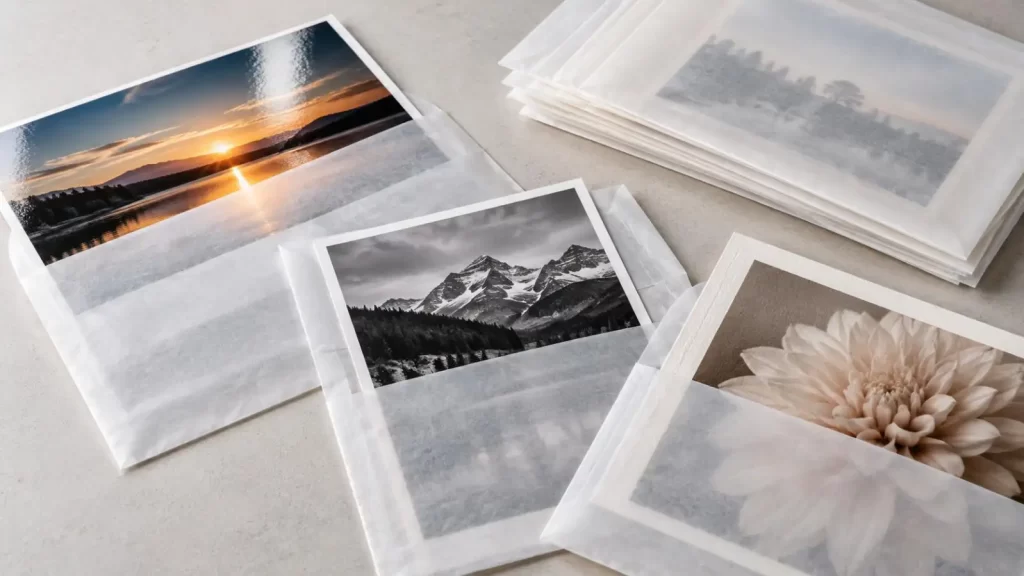
At GT GROUP, we have several considerations when analyzing photographic packaging, namely, the characteristics of the print, the properties of the paper and the conversion requirements. Glassine may be an alternative for some types of temporary handling. However, for long term storage, it should not be used for photographic prints.
1. Interaction of Glassine envelopes with Photo Surfaces
Glassine is made of photographic paper that has a very fine and even calendering of fibers. It has low porosity and good strength.
Though glassine meets many of the requirements for a photographic negative and print substrate, there are concerns from friction, moisture and time.
•Mechanical friction: Repeated use will cause paper to become abraded.
•Moisture absorption: elevated humidity will cause the paper to swell and increase surface adhesion.
•Chemical interaction: Over time, the different layers of the negative and print, will become unstable and deteriorate.
Of the three, moisture will always be of the highest concern.
2. Effect of Glassine envelopes on Different Printing Technologies
Some of the differences in the structures of photographic prints, as a result of the varying techniques used to produce them, play a key role in determining material compatibility with photographic packaging.
| Print Technology | Surface Structure | Potential Contact Risk | Packaging Consideration |
| Silver Gelatin | Silver image within gelatin emulsion | Chemical staining, blocking under humidity | Use verified archival enclosures |
| Chromogenic Prints | Dye image in gelatin-based layers | Moisture-related adhesion, chemical deterioration | Test chemical compatibility |
| Dye-Based Inkjet | Soluble dyes in receiving layers | Dye migration, coating damage | Avoid unverified direct contact |
| Pigment-Based Inkjet | Pigments within surface coatings | Abrasion, scuffing, gloss changes | Evaluate surface friction |
| Dye-Sublimation | Diffused dyes, often with an overcoat | Heat-related sticking, coating interaction | Test finished-print compatibility |
Silver Gelatin and Chromogenic Photographs
Gelatin layers respond to moisture, while silver images may be affected by unsuitable enclosure chemistry. Conventional glassine should not be used as a substitute for tested archival paper.
Inkjet and Dye-Sublimation Prints
Dye-based inkjet coatings can be sensitive to moisture and humidity. Pigment-based prints may exhibit surface scuffing or gloss changes during handling.
Compatibility with dye-sublimation is partly influenced by the protective overcoat and contact conditions.
Therefore, an evaluation of Glassine Envelopes for Photos needs to be print specific and cannot claim universal compatibility.
3. Technical Parameters That Determine Packaging Performance
The specification of paper affects folding behavior, contact pressure and consistency in production.
| Parameter | Technical Influence | Quality Verification |
| Grammage (GSM) | Flexibility and mechanical support | Basis-weight measurement |
| Thickness (µm) | Fold formation and pocket clearance | Thickness testing |
| Surface Roughness | Contact friction and abrasion | Surface/contact testing |
| Moisture Response | Curling and expansion | Humidity conditioning |
| pH and Additives | Chemical interaction | Material analysis |
| Adhesive Placement | Staining and localized pressure | Seam inspection |
Why GSM and Surface Smoothness Are Not Enough
Stiffness can result from a high grammage. However, excessive stiffness can create folds that lead to localized pressure.
Likewise, a smooth surface does not eliminate chemical contamination or moisture related sticking.
Chemical stability, surface behavior, and dimensional accuracy should be considered in conjunction for Glassine Envelopes for Photos.
4. Glassine vs Wax Paper vs Archival Materials
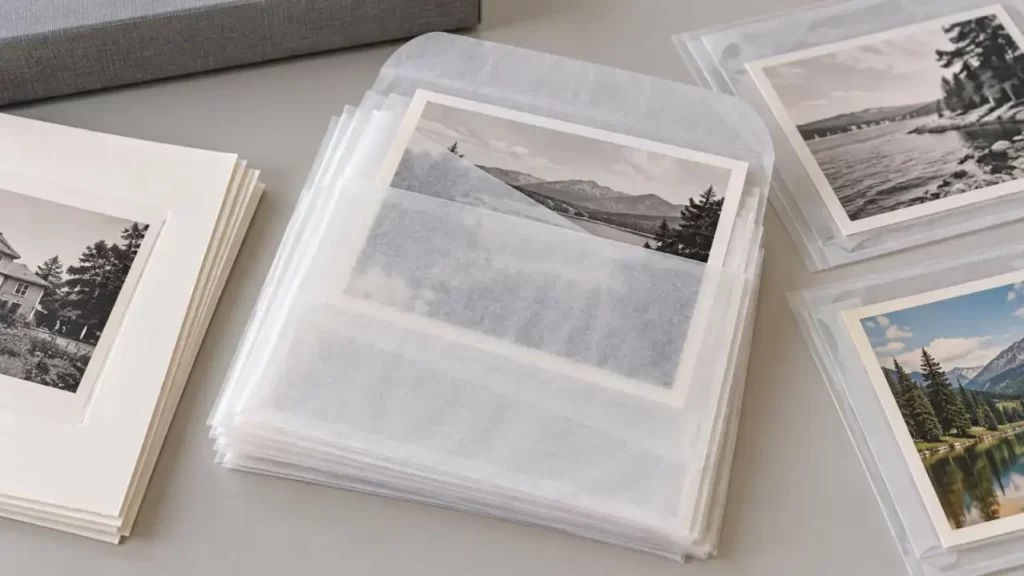
At GT GROUP, our paper packaging range includes wax treated kraft and white paper bags. These materials differ fundamentally from glassine.
| Material | Manufacturing Characteristic | Appropriate Application |
| Glassine | Densified, highly calendered paper | Selected temporary packaging uses after verification |
| Wax Paper | Paper with applied wax treatment | General-purpose and food-related packaging |
| Qualified Archival Paper | Tested chemical and physical properties | Long-term photographic storage |
| Archival Polyester | Stable, uncoated plastic film | Suitable photographic storage and viewing applications |
Wax-coated paper is not equivalent to glassine, and food-contact suitability does not demonstrate photographic safety.
For valuable photographic collections, buyers should seek enclosures that comply with recognized preservation requirements.
5. Testing and Manufacturing Precision for Photo Envelopes
Iso Standards and Material Verification
Before deciding on Glassine Envelopes for Photos, buyers should be familiar with the following two standards:
•ISO 18902:2013: Specifies the physical and chemical requirements of storage and display of photographs.
•ISO 18916:2025: Establishes the Photographic Activity Test (PAT) for processed silver-gelatin materials and for other photographic processes.
Passing the PAT doesn't guarantee archival suitability and other factors like inkjet, sticking, abrasion and adhesive migration should also be assessed. The most useful test to assess contact behavior is a representative test.
Dimensional Design and Production Control
A standard 4 x 6-inch photograph measures 101.6 x 152.4 mm.
For example, a pouch with a 106 x 157 mm internal pocket offers:
•Clearance on the width of 4.4 mm total.
•Clearance on the length of 4.6 mm total.
•Nominal side clearance of 2.2 mm when centered.
These values are for illustration, and should not be taken as confirmed manufacturing tolerances of GT GROUP.
When individual orders are placed for photo envelopes, the following should be defined:
•Cutting tolerance: Defines the maximum deviation permissible from the dimensions defined in the drawing.
•Folding alignment: Control of the position of the folds and pocket geometry.
•Seam placement: Placement of adhesives away from image-contact areas is required.
•Material consistency: The GSM range and thickness of the material should be defined.
•Batch Inspection: Samples are to be inspected against the approved specification.
The inner (usable) dimensions should be measured after folding and sealing. It should be noted nominal flat sheet dimensions do not ensure adequate print clearance.
Packaging Supplier Selection, GT Group's View
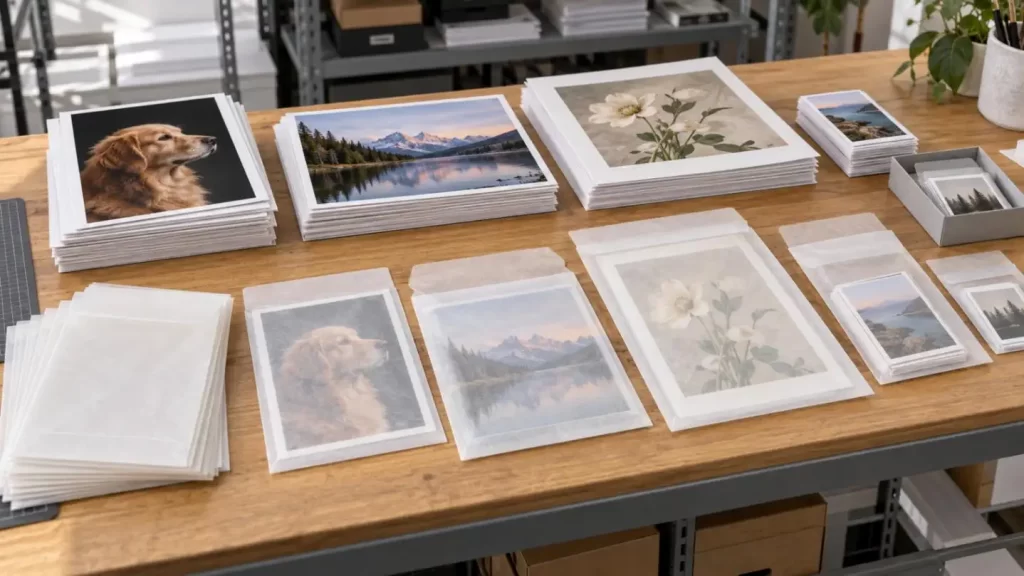
When evaluating Glassine Envelopes for Photos, one should consider the expected print type, anticipated handling and storage conditions, required material testing, and anticipated print clearance.
In our food grade wax paper bags, we use either kraft or white paper, apply a wax coating, perform folding and/or cutting, and provide a resealable closure. We also offer custom graphic and logo design services for packaging.
For businesses in the product photographic presentation packaging, printed product sleeves, and custom paper pouches, we can consider closure configurations, materials and verification requirements, as well as propose potential designs and dimensions.
For further information on our Custom Wax Paper Packaging, as well as to discuss your packaging needs, contact us.
FAQs
Q1. How does GT GROUP approach dimensional accuracy?
Custom projects can define cutting dimensions, folding alignment, and seam placement. Actual manufacturing tolerances should be confirmed through approved samples
Q2. What materials does GT GROUP use for paper packaging?
GT GROUP offers kraft paper, white paper, wax-treated paper, and glassine-based packaging options for different applications.
Q3. Can GT GROUP customize envelope sizes for photo prints?
Yes. GT GROUP supports custom packaging dimensions. Buyers should provide print sizes, required clearances, and structural specifications.
Q4. What closure options are available from GT GROUP?
GT GROUP's wax paper bags feature resealable strips. Other closure configurations should be confirmed during customization.
Q5. Does GT GROUP offer custom printing for paper envelopes?
Yes. GT GROUP supports customized logos and packaging designs, subject to material and printing requirements.
Share on Social:


