


Eco-Friendly Cushioning Material for Shipping: Recycled Fiber vs. Virgin Kraft Paper


When comparing eco-friendly cushioning materials for shipping, assessing recycled content is just the beginning. There are differences in fiber structure, mechanical strength, and resilience to moisture as well as the consistency of manufacturing for both recycled fiber and virgin kraft paper.
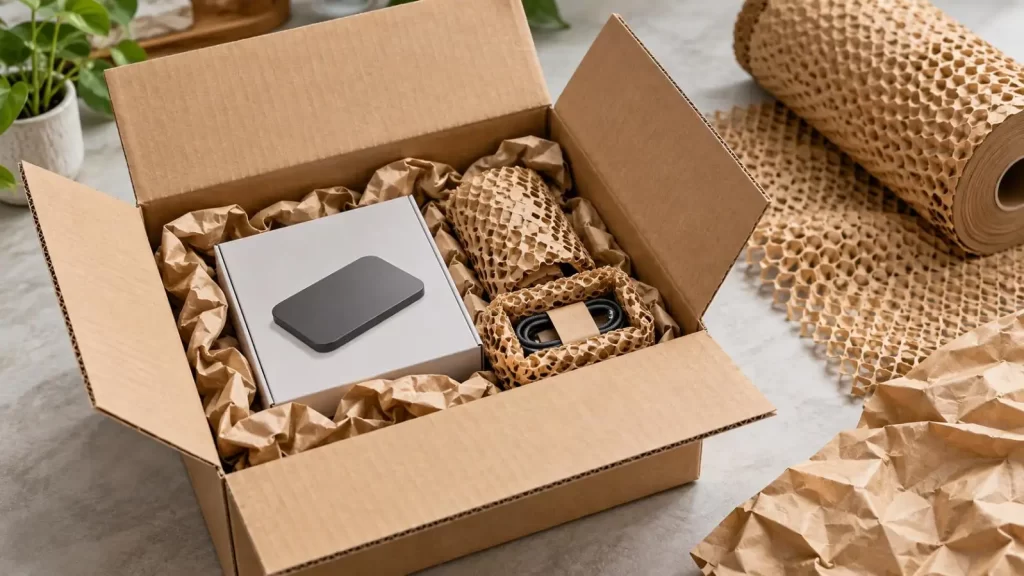
Generally, strengths of virgin kraft paper can be more easily predicted, and properly engineered recycled paper can provide adequate cushioning for many shipping applications. At GT GROUP, the properties of the material and the conditions of transportation are considered when assessing protective shipping packaging made of paper.
1. Recycled Fiber vs. Virgin Kraft Paper: Anatomy of Fibers
Fiber morphology greatly influences the mechanical properties of kraft paper.
Virgin Kraft Paper
Virgin kraft paper is made from fully intact, recently processed fibers. Kraft pulping helps retain fiber strength making certain grades of the paper stronger and more appropriate for wrapping and converting.
Recycled Fiber Paper
Paper made of recycled fibers has gone through the pulping process and papermaking process several times. In the cycle, the fibers can become hornified. Hornified fibers are less porous and less able to swell and bond to neighboring fibers.
Regardless, recycled paper can be strong. How strong it is depends on:
•The length of the fibers: Affects the tensile and tear strength of the paper
•Fiber Mix: Balancing the strength of the paper
•Contamination: Weaknesses can be introduced during processing
•Interfiber bonding affects the resilience of the paper to separating.
When looking at eco-friendly cushioning materials for shipping, both the fiber composition and overall structure should be analyzed.
Recycled vs. Virgin Kraft Paper: Mechanical Performance Comparison
| Performance Factor | Recycled Fiber Paper | Virgin Kraft Paper |
| Tensile Strength | Varies | More predictable in comparable grades |
| Tear Resistance | Can be strong with adequate long fibers | Strong |
| Compression Behavior | Influenced by GSM and cushioning structure | Influenced by GSM and cushioning structure |
| Moisture Sensitivity | Requires humidity conditioned testing | Also affected by moisture |
| Material Consistency | Depends on recovered fiber sorting and processing | Depends on pulp and production control |
| Sustainability | Uses recovered fiber | Can use responsibly sourced virigin fiber |
Why GSM Alone Cannot Predict Cushioning Performance
Paper grammage, expressed in g/m² (GSM), describes mass per unit area. It does not describe shock absorption.
It is a common misconception that increasing grammage improves cushioning performance. Thickness may also not always be a reasonable way to achieve higher cushioning performance.
There are generally three factors to assess cushioning performance:
•The first factor is the effect of tensile strength. The lower the tensile strength of the sheet, the higher the cushioning performance.
•The second factor is the effect of tearing resistance. If a sheet is torn or cut, it may affect the cushioning performance.
•The third is the ability to respond to compression. The cushioning structure must have the ability to deform to absorb impact.
A paper of a higher tensile strength does not necessarily result in a lower impact acceleration during shipping.

3. How Honeycomb Geometry Changes Cushioning Performance
Considering structural design other than the type of fiber, what else should we consider?
When honeycomb cushioning paper is stretched, a 3-dimensional structure like that of a honeycomb is created.
The performance of a cushioning material is affected by the following:
•Expansion Behavior of the Cells and Slit Geometry: This determines the thickness of the cushioning and the opening of the cells.
•Configuration of the Layers: This determines how much the cells of a cushioning structure can be compressed.
•The Strength of the Paper: This also determines how much a cushioning structure can be compressed.
•If the paper is not strong enough, the compressive forces can cause it to break/tear.
•Manufacture of honeycomb paper by GT GROUP involves cutting, slitting and stretching of kraft paper.
It is important that the expansion behavior of the paper be uniform during manufacturing in order to ensure that cushioning contacts are uniform.
4. Selection of Paper Cushioning Materials for Different Shipping Conditions
Choosing the right material depends on the fragility of the product, weight of the package, clearance in the package, and the environment the package is exposed to.
| Shipping Application | Recommended Evaluation |
| Lightweight e-commerce products | Volumetric strength, stability of the structure, and material usage |
| Glassware and ceramics | Cushioning effect, thickness and protection layers |
| Industrial components | Tearing, protection against abrasion, and concentration of loads |
| Humid or long-distance shipping | Moisture conditioning and retention, stability of the structure |
In transportation, paper cushioning materials may be used in place of plastic bubble wraps. However, whether it is recycled or virgin paper, the materials should be tested for humidity and climate conditions of the transport.
5. Total Packaging Cost and Sustainability
Incorporating more recycled content may not reduce the environmental footprint of a product. Other factors, such as energy used in the processing of recovered fiber, manufacturing and transportation, the weight of the package, and end of life treatment, must be taken into account to make an informed comparison.
Environmental Claims must distinguish between:
•FSC Recycled – All fiber from a recycled source.
•FSC Mix – A combination of certified, recycled, and controlled sources.
•FSC 100% – Material from an FSC certified source.
Recyclability, biodegradability and compostability are separate claims and require supporting evidence.
For procurement, the total packaging cost should be considered, rather than paper cost alone. The total packaging cost includes: the cost of the material, the cost of labor for packing, the cost of transportation, and the expected cost for damage during transport.
If the cost of transporting a recycled sheet increases due to increased shipment layers, the recycled sheet would be more expensive than a virgin fiber sheet.
6. Manufacturing Precision, Testing and Supplier Verification
For bulk Eco-Friendly Cushioning Material for Shipping, dimensional and mechanical consistency should be verified prior to production approval.
At GT GROUP, we customize the material, size and thickness, and type of packaging. We offer cushioning in 20 × 30 cm and 30 × 40 cm sizes. Other sizes can be customized.
Key Manufacturing and Testing Parameters
| Quality Parameter | Measurement / Verification |
| Paper grammage | GSM (g/m²), ISO 536 |
| Tensile properties | ISO 1924-2 |
| Tear Resistance | ISO 1974 |
| Width and cutting precision | Actual dimensions and deviation in mm |
| GSM consistency | Batch variation expressed as percentage |
| Honeycomb expansion | Expanded dimensions and cell uniformity |
| Shipping Protection | ISTA 3A, where applicable |
Numerical tolerances of GT GROUP's GSM, cutting dimensions and expansion consistency should be aligned against the agreed product specification and not presumed from catalog information.
Our process includes reviewing requirements, providing a quotation, approving samples, production and quality control.
Before making a bulk purchase, customers are encouraged to evaluate the material specifications and certifications, representative samples, and measurable acceptance criteria.
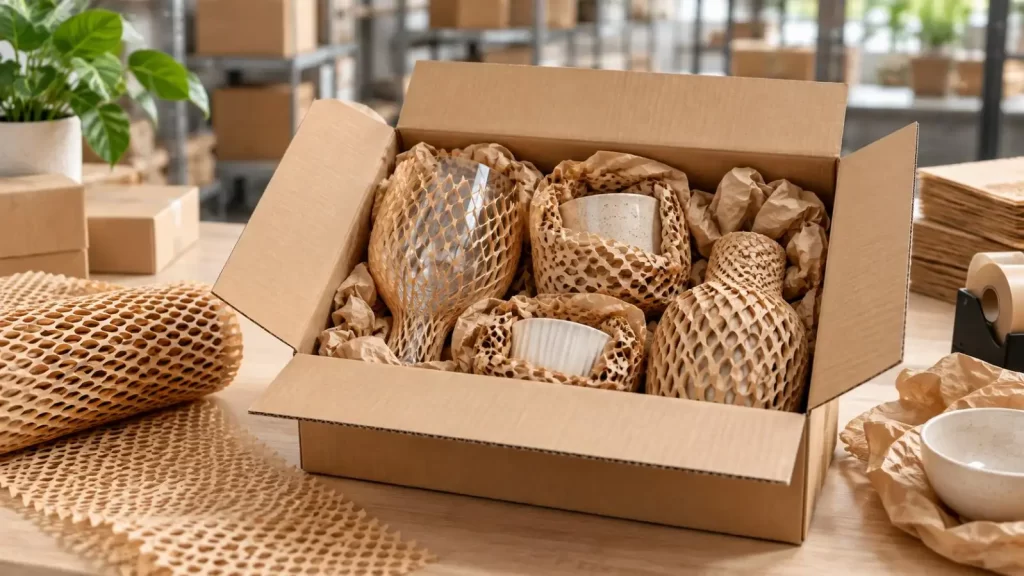
Choosing Eco-Friendly Cushioning Material for Shipping with GT GROUP
Neither of the two are universally better. Relative decision making is based upon required strength, cushioning structure, humidity exposure, environmental documents and total shipment cost.
We offer different paper cushioning solutions for various shipping applications, from retail goods to industrial parts.
For sample evaluation of eco-friendly cushioning materials or for further discussion on paper specifications, contact us.
FAQs
Q1. What Eco-Friendly Cushioning Material for Shipping Does GT GROUP Supply?
GT GROUP supplies paper-based cushioning materials, including honeycomb paper and kraft cushioning paper, for product wrapping, void filling, and shipping protection.
Q2. Does GT GROUP Offer Recycled and Virgin Kraft Paper Cushioning?
GT GROUP's paper cushioning range includes products made from kraft paper or recycled pulp. Buyers should confirm the fiber composition and available grades for each product.
Q3. Can GT GROUP Customize Paper GSM and Cushioning Dimensions?
Yes. GT GROUP supports OEM/ODM customization of material, thickness, size, and packaging specifications. Actual GSM options and tolerances should be confirmed during quotation.
Q4. How Does GT GROUP Control Honeycomb Paper Manufacturing Quality?
GT GROUP's honeycomb paper production involves cutting, slitting, and expansion. Buyers can request specifications for paper grammage, dimensions, and expansion consistency.
Q5. Is GT GROUP's Recycled Paper Cushioning Suitable for Fragile Products?
Paper cushioning can protect glassware, ceramics, and other fragile products. Suitability depends on product weight, cushioning configuration, and shipping conditions.
Share on Social:


