


Cushioning Material for Fragile Items: Corner Protection for Ceramic Products


Cushioning Material for Fragile Items must protect ceramics in more ways than just surface abrasion. A mug can arrive with an intact body and a fractured handle; a plate can arrive with edge chips despite multiple layers of wrapping paper.
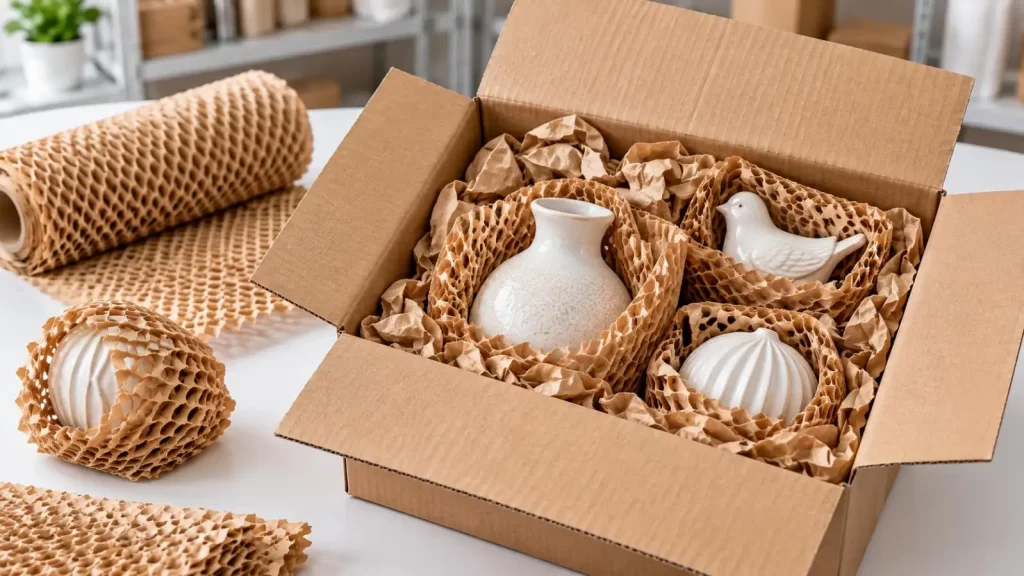
Packaging failures are typically caused by localized impact, insufficient clearances, and uncontrolled movement within the carton. In assessing ceramic packaging at GT GROUP, we evaluate material deformation, load distribution and structural protection as opposed to wrap thickness alone.
Ceramic Corners Fail During Shipping
It is because of ceramic materials' propensity towards brittle fracture that the failure of ceramic packages during transit is extremely prevalent.
•The strength of a thin rim between a body of a ceramic package and a support surface may not be sufficient to support the load, and may fail by contact stress.
•Cushioning may not be sufficient to prevent ceramic packages from coming in direct contact with the rigid walls of the carton.
•Vibration during transit can cause ceramic packages to collide with one another, and with the carton walls.
Edge chipping can be controlled by surface wrapping. Corner and other load concentrating regions can be supported and protected by internal reinforcing members.
How Cushioning Material for Fragile Items Controls Impact
Inherent in all protective cushioning is the ability to compress and slow down the load being carried. Peak transmitted force and acceleration are also limited to an acceptable range.
Cushioning Thickness, Static Stress, and Compression
The range of static stress supported by cushioning materials is estimated by dividing the supported load by the effective bearing area. This determines the lower bound for use of cushioning materials.
However, for dynamic deformation to occur, cushioning should have a certain thickness to limit hard contact with the protected corners. The thickness of cushioning can be estimated by dividing supported load by the allowable stress of the cushioning material.
•Insufficient Give: The material may transfer the force before it has the chance to deform enough to absorb shock.
•Inadequate Recovery: The cushioning may gradually lose its thickness and effectiveness with continuous impact.
Paper grammage (GSM) does not typically correlate with shock absorption. Other elements like the type and geometry of the fibers, humidity and the thickness of the material may affect shock absorption.
Honeycomb Structure and Load Distribution
The honeycomb structure is made up of interconnected cells, providing flexible wrapping and spacing.
If compressed, the cells may deflect and shock may be absorbed through bending and buckling. The response is dependent upon the cell geometry and degree of expansion.
Honeycomb paper may help protect vulnerable ceramic corners, but dedicated supports may be needed as well.
Cushioning for Fragile Items
Different materials provide different protective functions. Buyers should identify the functions such as surface protection, impact protection and structural fixing.
| Material | Main Function | Suitable Application | Technical Limitation |
| Honeycomb Paper | Flexible wrapping and cellular separation | Mugs, ornaments | Limited rigid corner support |
| Paper Bubble Cushioning | Surface protection | Lightweight ceramics | Performance varies based on embossed geometry |
| Crinkle Paper | Restrict movement and filling empty space | Small gift packaging | Limited concentrated load |
| Molded Pulp | Shaped support and load distribution | Plates, Standardized ceramics | Product fit specific |
| EPE Foam | Shaped cushioning | Heavy and delicate ceramics | Plastic based |
Can Paper Cushioning Replace EPE Foam?
Paper cushioning, like EPE foam, may absorb shock and protect packages, but equivalency needs to be validated through package testing. For heavier ceramics, for example, some type of foam may be better than paper-based cushioning. Protection may also require some type of support and/or clearance.
Material cost has to be weighed against packing time, shipping weight, dimensional weight and verified damage rates.
Designing Protective Packaging for Different Ceramics
The correct Cushioning Material for Fragile Items depends on product geometry, mass, fragility, and distribution conditions.
| Ceramic Product | Critical Damage Area | Recommended Packaging Configuration |
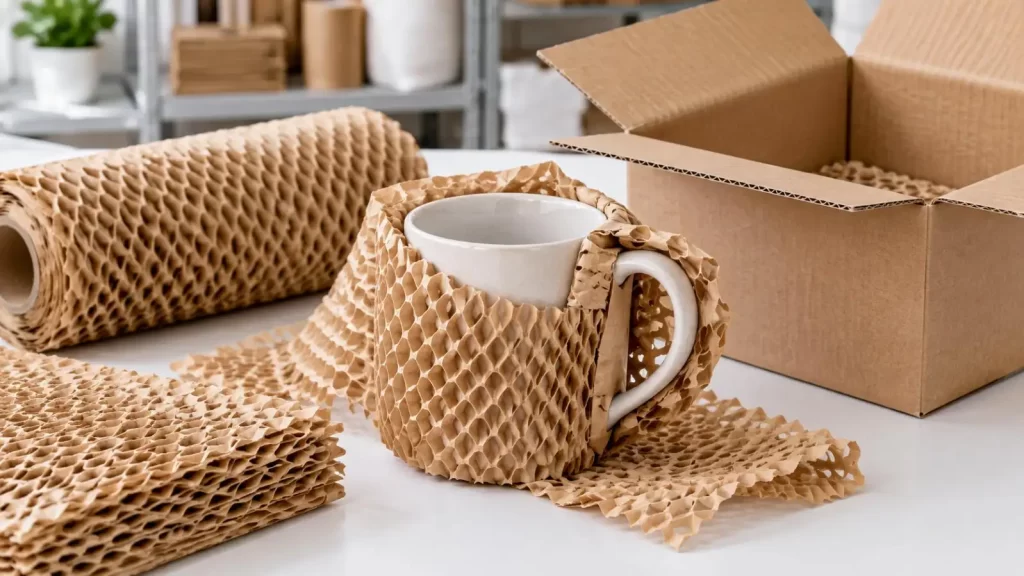
| Ceramic Mug | Handle and rim | Individual wrap, handle clearance, fitted support |
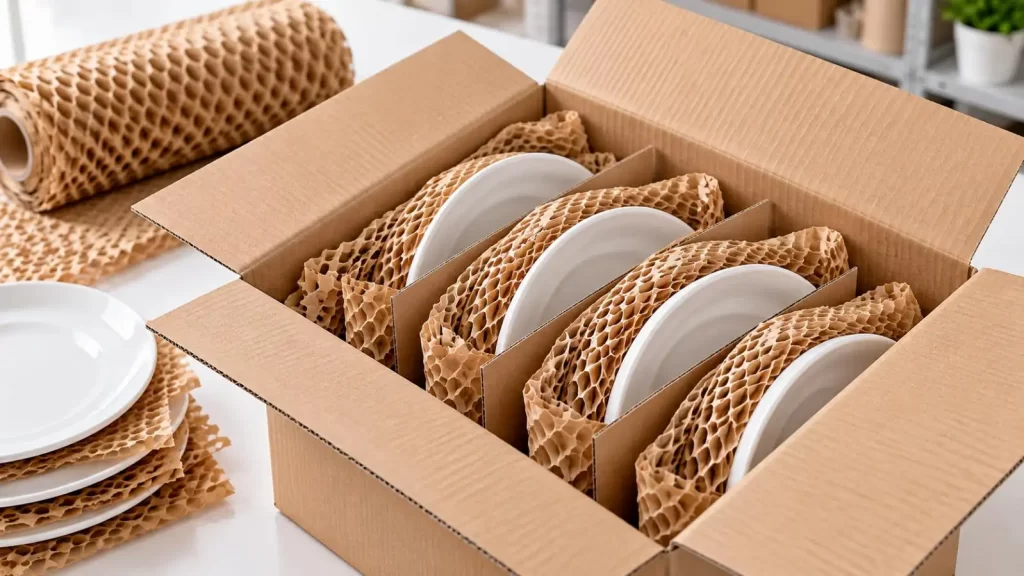
| Ceramic Plate | Thin rim | Surface separators, edge supports, rigid dividers |
| Ceramic Ornament | Protruding corners | Conforming wrap, reinforced supports, immobilization |
Four Packaging Design Requirements
Identify vulnerable contact points such as edges, handles, protrusions, and thin wall sections.
•Avoid clearance issues. Allow sufficient space for the product to deform the carton, but leave enough clearance for product to product contact.
•Avoid collisions. Use individual product wrappings, separators and supports to prevent product collisions instead of relying on loose fill to prevent collisions.
•Confirm adequate layers. Determine adequate layer count for product through testing and/or accounting for material compression and product weight.
Settling loose cushioning may allow edges to come into contact with other product edges.
Prevent ceramic to ceramic contact is especially critical when cartons contain multiple product items.
Testing Cushioning Material for Fragile Items
It is not possible to guarantee packaging reliability based on material specifications alone. Therefore, we suggest performing a qualitative evaluation of cushioning and a quantitative evaluation of complete packages.
| Test Method | Evaluation Objective |
| ASTM D1596 | Dynamic cushioning response under specified impact conditions |
| ASTM D5276 | Loaded-package free-fall resistance |
| ISTA 3A | Distribution simulation for applicable parcel shipments |
| ASTM D642 | Container compression resistance |
ASTM D1596 can characterize cushioning behavior, but results depend on specimen thickness, contact area, and loading conditions. They do not guarantee equivalent performance inside a finished package.
•Product condition: Edge chipping, hairline cracks, and fractures
•Cushion conditions: Permanent compression, displacement, or collapse
•Package condition: Divider movement, carton deformation, and loss of clearance
Humidity conditioning and repeated-impact evaluation are especially relevant when selecting paper cushioning for international shipments.
GT GROUP: Manufacturing Control and Bulk Purchasing Requirements
The GT GROUP product portfolio comprises a wide range of products based on paper and paper-based cushioning materials, from honeycomb paper to void-filling materials.
The cellular structure of our honeycomb paper is expanded via a stretching process.
One of our products made of honeycomb paper has nominal dimensions of 20 x 30 cm and 30 x 40 cm. We supply 50 pieces in a bag.
For large orders of Bulk Cushioning Material for Fragile Items, measurable acceptance criteria should be defined.
| Paper Grammage | Target GSM and allowable variation |
| Honeycomb Geometry | Slit spacing and expansion uniformity |
| Cushioning Behavior | Expanded thickness and compression response |
| Batch Consistency | Sampling plan and inspection records |
| Dimensional Precision | Width, cut length and agreed tolerances |
We provide customers the flexibility to adjust material, thickness and packing configurations through our OEM/ODM services. Rejected/accepted samples are inspected prior to bulk production.
Explore Our Eco Cushioning Solutions
At GT GROUP we assist customers in evaluating paper based protective materials for their packaging needs. Whether you are considering ceramic tableware, decorative products or fragile e-commerce shipments, material choice should be based on the product geometry and verified protection needs.
Check out our Eco Cushioning Materials and get in touch if you would like to discuss custom cushioning specifications and sample assessment.
FAQs
Q1. What cushioning materials does GT GROUP manufacture?
GT GROUP offers paper-based cushioning materials, including honeycomb paper and paper bubble cushioning, for protective wrapping and void filling.
Q2. Can GT GROUP's cushioning materials protect ceramic products?
Yes. Our paper cushioning materials can help protect ceramic surfaces and limit movement. Fragile corners may require additional structural supports and package testing.
Q3. Does GT GROUP provide customized cushioning materials?
Yes. We offer OEM/ODM services covering material selection, dimensions, thickness, printing, and packaging configurations.
Q4. Is GT GROUP a direct cushioning material manufacturer?
Yes. GT GROUP operates as a direct packaging manufacturer, offering factory sourcing, customized production, and quality control.
Q5. What honeycomb paper sizes are available from GT GROUP?
One of our listed honeycomb paper products offers 20 × 30 cm and 30 × 40 cm sizes. Other dimensions can be discussed through customization.
Share on Social:


