


Sustainable Alternatives to Bubble Wrap: Moisture Resistance of Paper and Biopolymer Packaging


Sustainable Alternatives to Bubble Wrap should provide humidity protection throughout storage and transit. Paper-based materials can't offer limited protection against humid environments because they absorb moisture from the air. Biodegradable polymer films, on the other hand, are moisture barriers because water vapor can pass through them. How fast water vapor can diffuse through them depends on their structure and formulation.
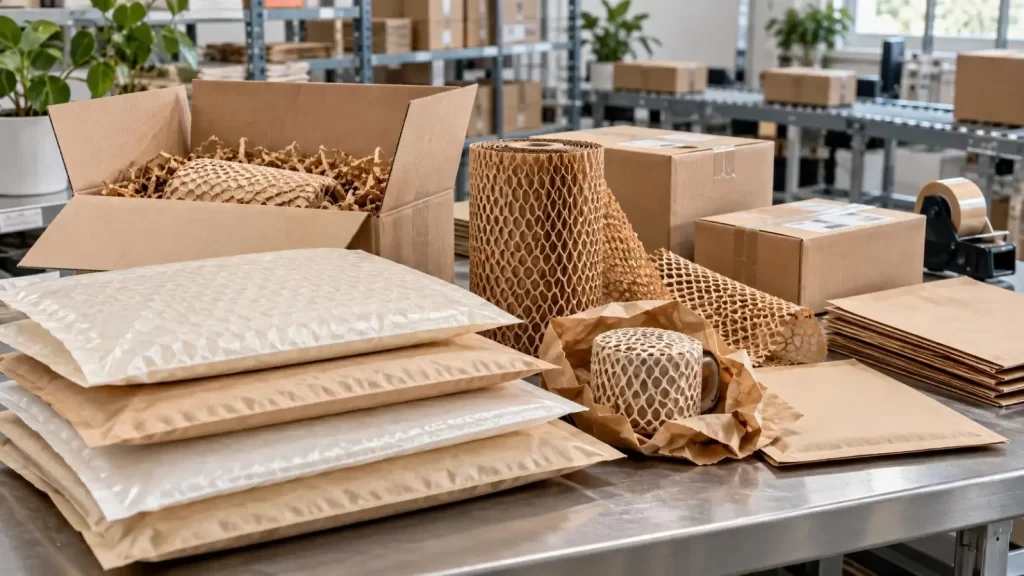
Moisture Protection is more complicated for packaging buyers than choosing between no moisture protection and some moisture protection. Moisture protection depends on water vapor transmission, the mechanical stability of the material, the quality of the seal and the actual transport conditions.
How Moisture Affects Sustainable Alternatives to Bubble Wrap
Moisture Absorption in Paper-based Cushioning
Cellulose fibers, found in honeycomb and paper cushioning, have hydroxyl groups that attract water. Moisture can alter the fibers' bond and impact the cushioning's mechanical properties. Higher humidity can result in less cushioning.
Absorbing moisture can also make the fibers swell, changing the volume of cushioning, and resulting in a poor fit and shape for the packaging, as well as affecting the cushioning's ability to retain its shape.
Using a water-repellent coating can reduce moisture absorption, but if the coating is discontinuous, it will not block the passage of water vapor.
Water Vapor Transport in PLA/PBAT Films
Water vapor can pass through biopolymer films by the process of sorption and diffusion, instead of passing through a cellulose fiber network like in the case of other cushioning materials.
Sensitivity to moisture can also vary depending on the type of starch, PBAT, and PLA used in the biopolymer film. A biodegradable film can resist water droplets but allow water vapor to pass through. Therefore, the three properties should be assessed separately.
Moisture Barriers Comparison: Paper vs Biopolymer Packaging
Different Sustainable Alternatives to Bubble Wrap provide trade-offs between cushioning, moisture exposure and end-of-life considerations.
| Material | Moisture Behavior | Main Limitations | Suitable Application |
| Kraft paper | Absorbs moisture | Reduced wet strength | Dry parcel shipping |
| Honeycomb paper | Changes cushioning with moisture | Moisture retention | Honeycomb structures Protective wrapping |
| Coated paper | Moisture barrier coating | Water uptake Defects and recyclability scenarios | Moderate moisture protective wrapping |
| PLA/PBAT bubble film | Continuous polymer barrier | Formulation dependency | Protective mailers |
| Paper-biopolymer composite | Fiber and film composite | Interface, sealing Complex | Customized protective mailers |
Continuous polymer films, compared to uncoated papers, provide stronger moisture barriers against direct contact with liquid water. Coated papers, however, may narrow this performance gap.
From a moisture barrier perspective, conventional polyethylene provides a good comparative benchmark. From a performance perspective, biodegradable films, in equivalent test conditions, should be assumed to provide similar protection.
In general, recycling and/or composting of packaging structures may be complicated by adhesives and coatings, and environmental claims should be assessed for the complete packaging structure rather than for individual components.
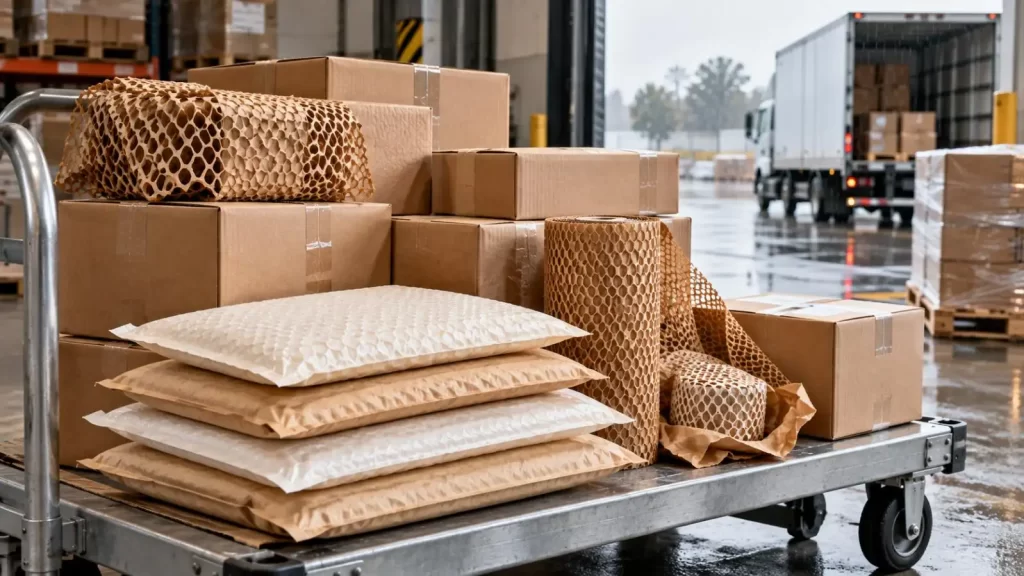
Evaluating Moisture Resistance: WVTR, Thickness, and Seal Integrity
For Sustainable Alternatives to Bubble Wrap, use measurable parameters as opposed to subjective descriptions like "waterproof" or "humidity-resistant"
| Parameter | Unit | Engineering Significance |
| Water Vapor Transmission Rate | g/m²/day | Measures vapor passing through a material |
| Cobb Water Absorption | g/m² | Evaluates liquid water uptake by applicable paper |
| Film Thickness | μm | Affects barrier and mechanical properties |
| Thickness Variation | μm or % | Indicates consistency |
| Seal Strength | N/15 mm | Determines joint integrity |
| Relative Humidity | % RH | Defines exposure condition |
Moisture resistance depends on polymer composition, crystallinity and the presence of defects, so a film with low WVTR may not be moisture resistant.
Seal integrity is also important. If seals are not completed, punctures develop or moisture enters through a closure, a film with low WVTR may provide inadequate moisture barrier protection.
Choosing Sustainable Alternatives to Bubble Wrap for Humid Shipping
The beginning of the packaging process is determining the sensitivity of the product and the distribution conditions.
| Shipping Condition | Primary Risk | Recommended Approach |
| Short, dry deliveries | Minor humidity exposure | Paper cushioning |
| Humid warehousing | Gradual moisture absorption | Coated paper or evaluated biopolymer films |
| Long-distance sea freight | Persistent humidity and condensation | Barrier structures and secondary protection |
| Electronic accessories | Corrosion and condensation | Validated moisture-barrier packaging |
| Cosmetics and gifts | Surface moisture and deformation | Cushioned mailers |
For some very moisture-sensitive electronics, biodegradable bubble mailers may not offer sufficient protection. Additional barrier protection may be required.
The final decision should consider cushioning retention, packaging weight, the potential for damage, costs, and the availability of waste disposal/processing.
Testing Moisture Resistance Before Bulk Production
Reliable Sustainable Alternatives to Bubble Wrap require material testing and finished package evaluation.
The tests available for evaluating the moisture barrier characteristics of films and other packages include:
| Standard | Description |
| ASTM F1249-25 | WVTR of polymer films using infrared detection. |
| ISO 2528:2017 | WVTR of sheet materials using gravimetric method. |
| ISO 535:2023 | Water absorptivity of paper and board using the Cobb method. |
| ASTM D4332-22 | Conditioning of Packaging Components. |
Other test methods may be used; however, they measure a specific property and thus should not be generally applied.
A practical verification procedure includes the following:
•Determine expected conditions (i.e., temperature and humidity).
•Determine WVTR or water absorption using the test most appropriate to the condition.
•Test films for defects and thickness.
•Condition completed packages to the expected conditions.
•Assess cushioning and compression.
•Agreement sampling should be used to set acceptance limits prior to bulk production.
Performing the actual shipment allows for assurance of various forms of damage that may have been introduced due to environment and handling conditions. Temperature cycling and condensation can be difficult to simulate in a lab.
GT GROUP: Manufacturing Control for Biodegradable Bubble Mailers
Combining film blowing, laminating, slitting, printing, and bag-converting processes, GT GROUP manufactures protective mailing solutions. We have 13 production units and five high-speed envelope production lines, enabling us to do customized packaging.
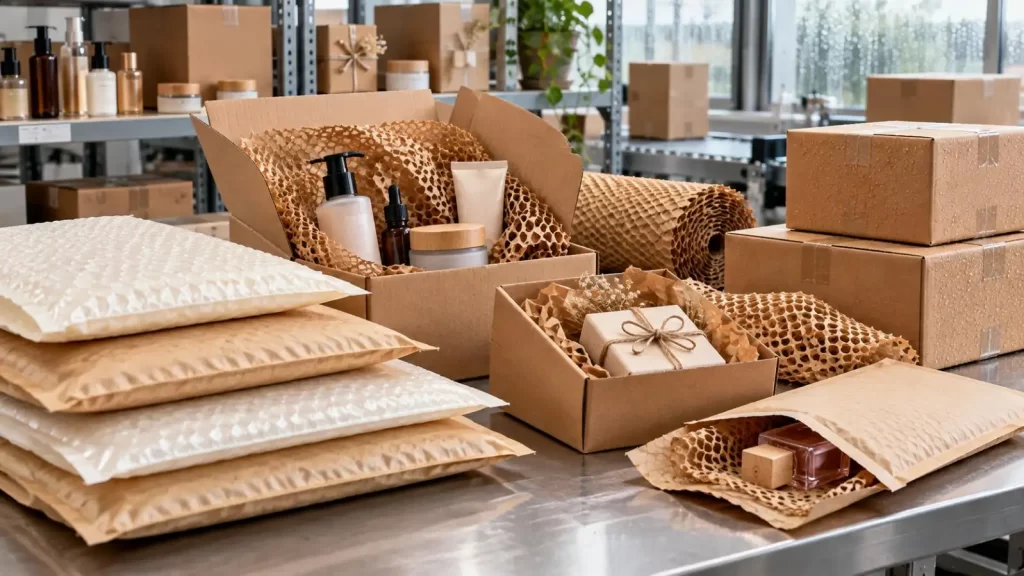
The bubble mailers we offer are composed of an air cushioning system and integrated with biopolymers PLA and PBAT, which make them biodegradable. We also provide OEM and ODM services, and can therefore customize size and thickness, as well as the material and graphics used.
In specifying moisture barrier packaging, processes and testing must be defined to be measured. For example:
•Consistency of film: nominal thickness (min/max)
•Sealing: seal joint strength, width, and evaluation for defects
•Barrier evaluation: assessing WVTR under selected conditioning temperature and relative humidity
•Precision of manufacturing: sampling and batch inspection
These are specification limits, not absolute performance limits.
When considering moisture barrier packaging, a balance must be struck between the level of protection required, sustainability of the material used, and the length of time moisture is exposed to the packaging. At GT GROUP, we take into account these three factors, and help our clients to do the same through specification and approval of samples prior to bulk account for production.
For a free consultation, contact us to learn more about our Biodegradable Bubble Mailers and other products!
FAQs
Q1. What sustainable alternatives to bubble wrap does GT GROUP offer?
We offer biodegradable bubble mailers, honeycomb padded envelopes, and paper-based cushioning solutions for different protective packaging needs.
Q2. What materials are used in GT GROUP's biodegradable bubble mailers?
Our biodegradable bubble mailers use plant starch, PLA, and PBAT-based material blends with an integrated cushioning layer.
Q3. Are GT GROUP's biodegradable bubble mailers moisture-resistant?
Our biodegradable bubble mailers are designed to resist moisture exposure. Actual water vapor barrier performance depends on film composition, thickness, sealing quality, and testing conditions.
Q4. Can GT GROUP customize biodegradable mailers for humid shipping?
Yes. We support customization of material, size, thickness, and structure. Moisture protection requirements should be verified through appropriate testing.
Q5. How does GT GROUP control manufacturing consistency?
Our manufacturing operations include film blowing, laminating, slitting, printing, bag conversion, and quality inspection to support consistent production specifications.
Share on Social:


