


Recyclable Poly Mailers and EU PPWR: Packaging Compliance Toward 2030


While recyclable poly mailers are giving e-commerce companies an incentive to start thinking about the EU Packaging and Packaging Waste Regulation (PPWR), merely using recyclable polyethylene in a shipping bag does not make the bag PPWR compliant.
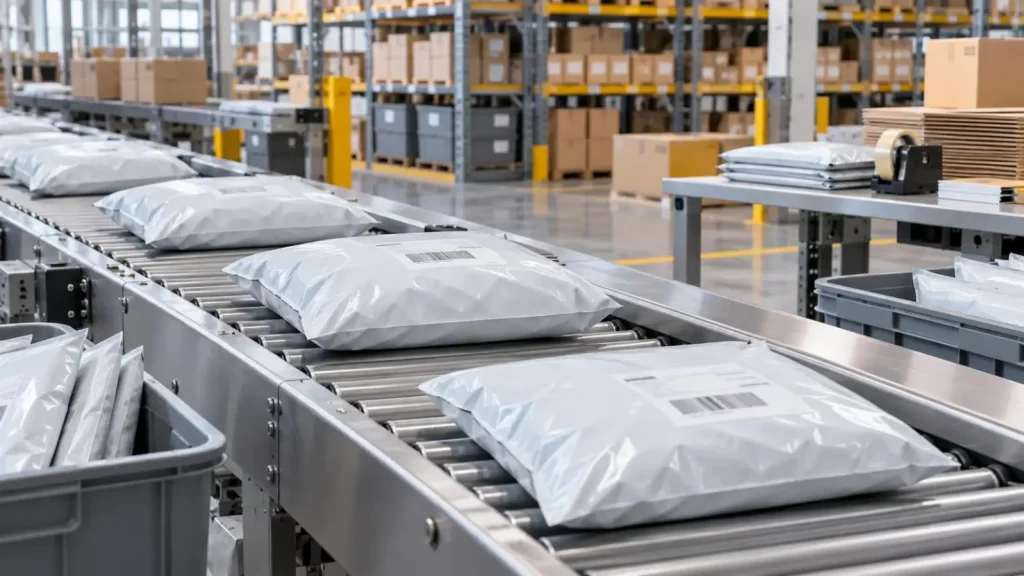
With regard to shipping packages, in addition to recyclability and recycled content, other requirements that may affect the packaging of goods and the documentation provided cover minimization of waste.
When looking at packaging from a usage perspective, there are always trade-offs. Film strength may impact shipping performance. On the other hand, shipping performance may impact sealing performance. These trade-offs pose a challenge for a manufacturer to achieve a middle ground.
1. What Does the EU PPWR Require for Recyclable Poly Mailers?
The full impacts of the PPWR will be realized in 2026, including requirements related to design for recyclability and recycled content of packaging.
| PPWR Requirement | Key Timeline | Implications for Poly Mailers |
| General PPWR application | August 2026 | The main obligations for packaging and the related administrative requirements for showing conformity. |
| Design for Recycling | 2030 or later, subject to delegated acts | Assessment of the recyclability of packaging materials and components. |
| Recycled Plastic Content | 2030 or later, subject to implementing acts | PCR (post-consumer recycled content) requirements for plastic packaging. |
| Harmonized Material Labeling | August 2028 or later | Standardized material identification for sorting |
| Empty-Space Limitations | 2030 or later, subject to implementing acts | Packaging dimensions and material optimization |
| Recycling at Scale | 2035 or later | Assessment of recycling beyond technical design |
The Regulation distinguishes between technically recyclable packaging and packaging that can be collected, sorted and recycled at scale.
Therefore, both manufacturers and buyers need to assess the complete mailing bag and cannot solely rely on its PE material designation.
2. How does PPWR Evaluate the Recyclability of PE Mailers?
PE Film and Recycling
Poly Mailers are made with PE (LDPE/LLDPE). Flexibility and moisture resistance help enable process Tensility and recycling.
There are other elements of the packaging that affect recycling.
•Film Structure: Recycling PE film becomes challenging when PE layers are laminated with other polymers.
•Adhesives: Self-sealing strips must be assessed for recycling.
•Printing Inks: If excessive ink is used or if there are pigments which are not easily removable, it can affect the recycling process.
•Shipping Labels: Labels, and adhesive residue left over from label removal can also impact the process and sorting of other materials.
PPWR Annex II establishes three recyclability performance grades:
| Grade | Recyclability Performance |
| A | ≥95% |
| B | ≥80% |
| C | ≥70% |
These thresholds reflect the EU Commission's benchmarks or targets to evaluate recyclability performance, as opposed to the actual rates at which recycled materials are collected. Further assessment should be based on the EU methodology that is applicable in the given case.
The use of mono-PE structure for mailers does not necessarily support recyclability. Also, paper mailers do not automatically take precedence. Also relevant should be the weight of the package, product moisture barrier protection, and the product's suitability.

3. Recycled Content vs Recyclability: What Changes by 2030?
How PCR Content Affects Film Performance
The consideration of recyclability and recycled content are independent of each other.
As discussed in Article 7, in the absence of PCR content, the recyclability of poly mailers can be achieved.
The baseline target for average weight percentage of PCR in plastic packaging (excluding packaging in contact with food and drinks) is 35% as stated by PPWR (Article 7). Transitional and final exemption dates need to be defined.
There are other challenges like:
•Melt flow and consistency of the resin
•Tensile strength and elongation at break
•Puncture and tear resistance
•Heat sealing
•Contamination control and batch traceability
PCR and PE blend may affect shipment performance, and more tests may be needed to address the issue.
Adding PCR may support the attainment of sustainability targets, but other challenges such as thickness of the film and sealing may also need to be modified and impact film performance.
4. How Can Recyclable Poly Mailers Reduce Packaging Waste?
Film Thickness, Sealing and Right-Sizing
Packaging minimization must be aimed at removing unnecessary packaging, while still ensuring the safety of the product.
Three major elements of mailer design require special consideration.
•Film Thickness: Thinner films require adequate puncture resistance and durability.
•Seal Reliability: The integrity of a heat seal is affected by a number of factors including the film's composition, the temperature and pressure applied during sealing, and the dwell time. Adhesive closures also need to be evaluated.
•Package Right-Sizing: It's also critical to package the right size to eliminate excessive package size.
•Package Dimensions: Mailers should be as small as possible to keep film usage to a minimum and to hold the product in place.
Empty space is restricted to 50% in PPWR Article 24 for transport and e-commerce packaging. This article also sets exceptions to this rule and defines means to achieve it. Empty space should be determined by calculation methodology as opposed to using a rigid volume formula for flexible mailers.
GT GROUP offers recyclable poly mailers in various sizes (i.e. 17x30 cm, 20x30 cm and 25x35 cm) and thus gives customers the opportunity to choose the correct size for their shipments.
5. How Should Buyers Verify Recyclable Poly Mailers for EU Compliance?
The recyclability of poly mailers is governed by their constitution, quality and level of stabilization. Therefore, testing should evaluate their regulatory documentation as well as the performance of the finished mailers.
| Verification Item | Technical Reference | Purchasing Purpose |
| Film tensile properties | ASTM D882 | Strength and elongation |
| Impact resistance | ASTM D1709 | Film resistance to impact |
| Seal strength | ASTM F88/F88M, where applicable | Heat-seal reliability |
| Recycled material traceability | EN 15343 | PCR sourcing and verification |
| Recyclability assessment | PPWR Article 6 / Annex II | Recycling compatibility |
| Conformity documentation | PPWR Annex VII / VIII | Regulatory evidence |
Mechanical testing alone cannot establish PPWR compliance.
Buyers should request material composition records, applicable evidence of recycled content, component information, manufacturing specifications, and supporting documentation demonstrating conformity.

Manufacturing Precision and Batch Consistency
Uniformity of film thickness impacts the amount of material used and the mechanical reliability of the product.
As an example, a film with a nominal thickness of 60 μm and a tolerance of ±5 μm indicates an 8.3% relative gauge variation. This is an illustrative example and not a declared GT GROUP manufacturing tolerance.
GT GROUP reports a total of 13 production units of various high-speed envelope and bag converting, printing, and film blowing systems, and quality control systems.
For custom orders, buyers should verify the agreed thickness tolerances, dimensional deviations, and acceptance criteria for seal strength, and sampling.
EU importers must confirm the responsibility and conformity assessment method and the EU Declaration of Conformity.
Cooperating With GT GROUP to Transform Poly Mailers for EU Markets
When implementing PPWR, a number of different aspects must be balanced, particularly in relation to packaging, protection, and performance.
In this case, we will consider the specification of packaging in relation to the thickness of the film.
Brands looking to modify their packaging to meet the requirements of the EU, are, through GT GROUP, able to access the sample evaluation of recyclable PE mailers.
For more information about Recyclable Poly Mailers, and to learn more about GT GROUP, please visit our website. You can reach out to us to understand your particular requirements, to access the relevant technical data and customize your packaging to meet EU requirements.
FAQs
Q1. What materials does GT GROUP use for its Recyclable Poly Mailers?
GT GROUP offers Recyclable Poly Mailers made from recyclable polyethylene (PE), providing lightweight, flexible, and moisture-resistant shipping protection.
Q2. What sizes of Recyclable Poly Mailers are available from GT GROUP?
GT GROUP offers standard options of 17 × 30 cm, 20 × 30 cm, and 25 × 35 cm. Buyers can inquire about additional custom dimensions.
Q3. Can GT GROUP customize Recyclable Poly Mailers for e-commerce brands?
Yes. GT GROUP supports logo printing, graphic customization, color selection, and packaging designs based on customer requirements.
Q4. Are GT GROUP's Recyclable Poly Mailers compliant with EU PPWR?
GT GROUP offers recyclable PE packaging, but material recyclability alone does not establish PPWR compliance. Buyers should request relevant technical documents and verify applicable requirements.
Q5. Does GT GROUP offer Recyclable Poly Mailers containing PCR materials?
The product specifications do not confirm a specific PCR percentage. Buyers should contact GT GROUP to verify available recycled-content formulations and supporting documentation.
Share on Social:


