


Thermal Insulation Roll Thickness Guide for Different Shipping Applications


Thermal insulation rolls are used in the manufacturing of thermal liner bags and liners for thermal shipping boxes for food delivery, e-commerce grocery shipments, beverage and other shipping distributions, and various others involving temperature-sensitive shipping.
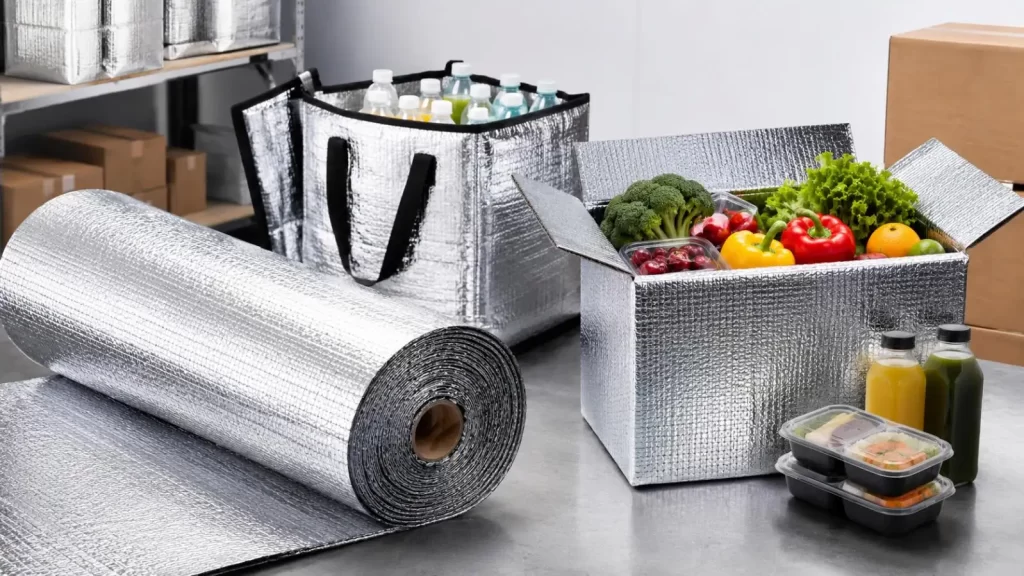
Constructions of thermal insulation rolls consist of metallized bubble film and aluminum laminated EPE foam. Reflective bubble rolls used in commercial packaging are available in thicknesses of approximately 3 to 8 mm. Aluminum laminated EPE rolls are in the range of 3 mm to 20 mm. The standard widths of rolls are 600 mm, 1000 mm, and 1200 mm, although wider rolls, or rolls in a cut-to-order widths, can also be manufactured.
The right thickness depends on the product, box size, transit time, ambient temperature, coolant quantity, and closure design. The following values should be treated as practical starting points for packaging trials rather than guaranteed temperature-hold times.
Common Thermal Insulation Roll Materials
Metallized Bubble Thermal Insulation Roll
This material normally combines an LDPE air-bubble layer with one or two reflective metallized surfaces. A common bubble diameter is approximately 10 mm, while standard roll widths are often 1,000 or 1,200 mm.
Recommended starting thicknesses:
•3–4 mm single bubble: local food delivery, chilled beverages, bakery products, and short e-commerce routes
•5–6 mm bubble structure: meal kits, fresh produce, dairy products, and same-day delivery
•7–8 mm double bubble: frozen foods, summer delivery, repeated handling, and longer regional routes
The Bubble-Based Thermal Insulation Roll is lightweight and easy to pack and ship where total weight and packing time are of importance. It also includes cushioning.
Aluminum-Laminated EPE Foam Roll
EPE foam has a closed-cell structure that provides some level of insulation, flexibility and protection from moisture and is more durable against compression when compared to light bubble film. Available thicknesses typically ranges from 3 to 20 mm, with standard roll widths of 600, 1000 and 1200 mm, and a usual roll length of 30 meters.
Suggested Starting Thicknesses:
•3 mm EPE foam: short duration food delivery, lightweight beverage packaging
•5 mm EPE foam: chilled groceries, meal kits, seafood, dairy products, and next-day parcels
•8 mm EPE foam: frozen food, summer distribution, large cartons, multi-stage delivery
•10 mm EPE foam: longer routes, high external temperatures, reusable delivery bags, and products requiring greater cushioning
•15-20 mm EPE foam: specialized reusable containers, pallet covers, or high-risk transport systems where packaging space is less restricted
Thermal Insulation Roll Selection by Application
| Shipping Application | Suggested Material | Reference Thickness | Typical Packaging Size |
| Restaurant Food Delivery | Metallized bubble or EPE | 3 – 5 mm | Bags up to 400 × 300 × 300 mm |
| Chilled Beverage Delivery | Metallized bubble | 3- 5 mm | Boxes up to 350 × 250 × 2 50 mm |
| Meal Kit Shipping | EPE foam or double bubble | 5 – 8 mm | 350-500 mm long cartons |
| Fresh Produce | EPE foam | 5 – 8 mm | 400 – 600 mm long cartons |
| Dairy and Seafood | Foil-laminated EPE | 5 - 10 mm | Medium cartons with gel packs |
| Frozen Food | Double bubble or EPE | 8 - 10 mm | Tight-fitting cartons with frozen coolant |
| Reusable Delivery Bag | EPE foam | 8 - 15 mm | Custom sewn or heat-sealed bags |
| Temperature-Sensitive Samples | Validated multilayer system | 10 mm or application-specific | Based on qualified payload design |
These values assume that the product is correctly preconditioned and that suitable gel packs, ice packs, or phase-change materials are used where required.
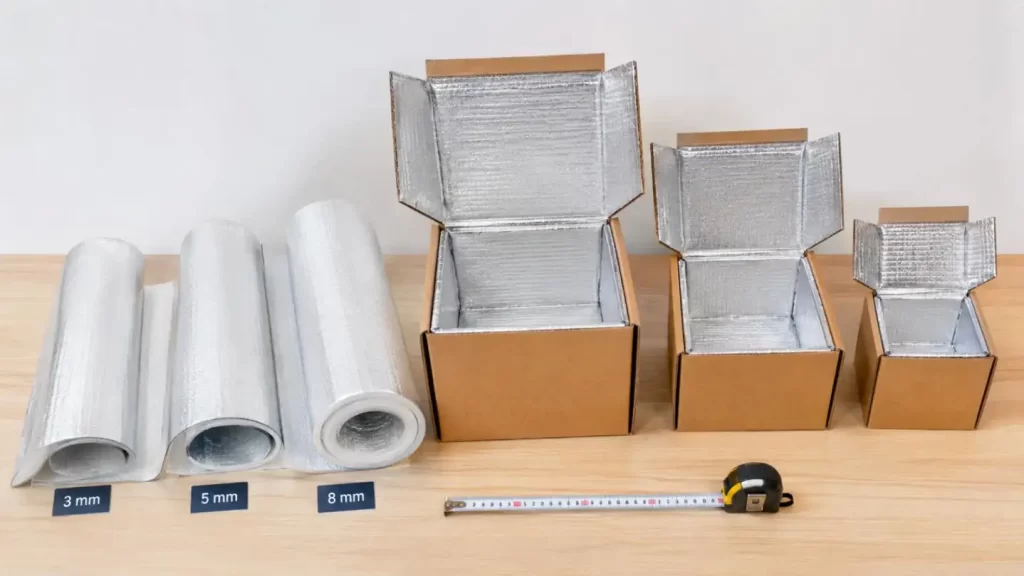
Choosing Thickness Based On Transit Duration
Up to 2 - 4 Hours
For your first experiments with restaurant meals, local beverages, and store-to-customer deliveries, we recommend the following options:
•3 mm metallized bubble
•3 - 5 mm aluminum-laminated EPE
•An insulated bag or box with a snug fit
•Low amount of empty space
This combination gives you the most flexibility and the least amount of packing weight while also being easy and fast to pack.
Approximately 4–12 Hours
For same-day groceries, meal kits, fresh produce, and regional delivery, consider:
•5–6 mm metallized bubble
•5–8 mm EPE foam
•Chilled gel packs placed above and around the product
•Sealed corners and full lid coverage
A 5 mm EPE structure may provide a practical balance between thermal resistance and usable box space.
Approximately 12–24 Hours
For next-day chilled shipping or more demanding summer routes, begin trials with:
•7–8 mm double-bubble material
•8–10 mm foil-laminated EPE
•Additional coolant on multiple sides
•Reduced internal air space
•A fully closed liner with overlapping flaps
The package should be tested against the expected warehouse, vehicle, and doorstep temperature profile.
Beyond 24 Hours
A Thermal Insulation Roll alone should not be assumed to provide reliable long-duration control. Extended transport may require:
•10–15 mm EPE foam
•Multiple reflective and insulating layers
•Phase-change materials
•A more rigid insulated shipper
•Qualified temperature testing
Strict cold-chain applications should be designed as complete systemsrather than selected based solely on liner thickness.
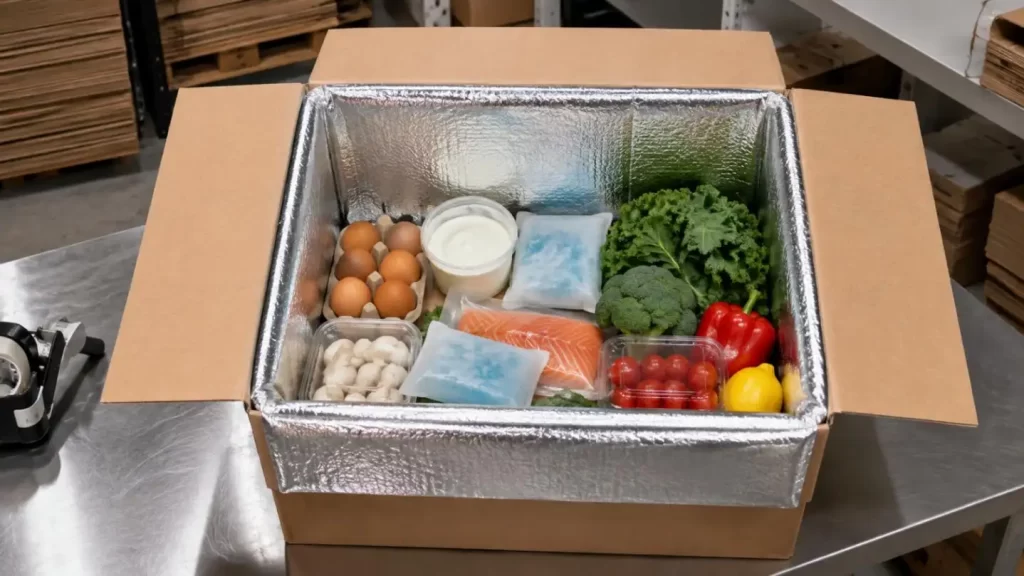
How Thickness Changes the Internal Box Size
A thicker liner reduces usable packaging space on every insulated side.
For a box with internal dimensions of 400 × 300 × 250 mm:
| Liner Thickness | Approximate Usable Interior |
| 3 mm | 394 × 294 × 244 mm |
| 5 mm | 390 × 290 × 240 mm |
| 8 mm | 384 × 284 × 234 mm |
| 10 mm | 380 × 280 × 230 mm |
The calculation is:
Usable dimension = original internal dimension − twice the liner thickness
A 10 mm liner therefore removes approximately 20 mm from the length, width, and height.
Choosing the Correct Roll Width
For a basic one-piece folded box liner, the approximate blank size can be estimated as:
Blank length = box length + 2 × box height + overlap
Blank width = box width + 2 × box height + overlap
Allow approximately 20–40 mm for overlaps or sealing.
| Internal Box Size | Approximate Blank Size | Practical Roll Width |
| 250 × 200 × 150 mm | 570 × 520 mm | 600 mm |
| 350 × 250 × 200 mm | 790 × 690 mm | 1,000 mm |
| 400 × 300 × 250 mm | 940 × 840 mm | 1,000 mm |
| 500 × 350 × 300 mm | 1,140 × 990 mm | 1,200 mm |
| 600 × 400 × 350 mm | 1,340 × 1,140 mm | Custom width or multi-piece liner |
The exact cutting pattern depends on whether the liner uses folded corners, separate panels, heat-sealed seams, or overlapping flaps.
Bubble Roll or EPE Foam?
Choose 3–8 mm metallized bubble Thermal Insulation Roll when the priorities are:
•Low packaging weight
•Fast cutting and folding
•Moderate cushioning
•Short or medium delivery periods
•Compact material storage
Choose 5–15 mm aluminum-laminated EPE Thermal Insulation Roll when the application requires:
•Better compression resistance
•Greater structural stability
•Reusable bag construction
•More cushioning
•Longer or more demanding delivery routes
Reflective bubble insulation should not be judged by thickness alone. One commercial box-liner specification uses a bubble structure around 3/16 inch, or approximately 4.8 mm, while emphasizing that material weight and reflective structure also affect performance.
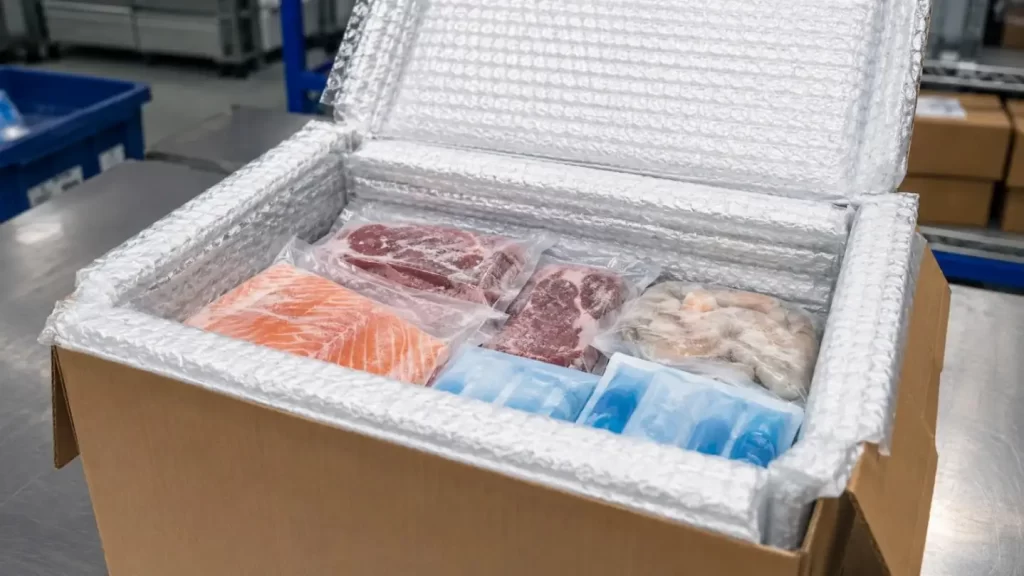
Finding the Correct Thermal Insulation Roll
A useful starting point for local delivery is 3 to 5 mm. Same-day or next-day chilled shipping usually requires 5 to 8 mm. 8 to 15 mm is recommended for frozen food shipping, summer routes, and systems that employ reusable thermal shipping systems.
The thermal insulation rolls from GT GROUP are well suited to thermal bag and box liner systems. These rolls can be made to fit different sizes of bags or cartons and also improve temperature stability and provide a good fit to bags or cartons while providing a neat interior to cartons.
To provide the best solution, GT GROUP needs to know your product details, internal box sizes, product weight, the method of coolant, the transit time, and the expected ambient temperature. Based on this information, GT GROUP can determine the best Thermal Insulation Roll by roll length, structure, thickness, and material.
FAQs
Q1. What is Thermal Insulation Roll used for?
Thermal Insulation Roll helps manufacturers make thermal bag liners and thermal box liners. Thermal bag liners and box liners can be used to package food and beverages for home delivery, transport groceries for online shopping, keep perishable produce fresh for delivery, and transport frozen foods.
Q2. What Thermal Insulation Roll thickness should I choose?
There are many factors that influence thickness selection; some of those are the product, the length of time it is in transit, the outside air temperature, the size of the box, and the type of coolant. For reference:
•3-5 mm: Short, local deliveries of lightweight drinks
•5-8 mm: Packaging Meal Kits or Grocery delivery that is chilled and done within a day
•8-10 mm: Transport of frozen food and delivery within a region on longer, summer routes
•10-15 mm: More demanding transport of products that need to be kept cold
These ranges must be evaluated through packaging trials.
Q3. Can GT GROUP customize Thermal Insulation Roll dimensions?
GT GROUP is able to customize roll dimensions in order to match the customer's box and bag designs. The customer must provide the requirements for the package's length, width, height, required overlap, and desired liner construction.
Q4. What roll width is suitable for a thermal box liner?
Thermal Insulation Rolls come in approximate widths of 600 mm, 1000 mm, and 1200 mm. A 600 mm roll would be suitable for small food delivery boxes, while 1000 mm or 1200 mm rolls suit medium and large boxes. Larger boxes may require a roll that is a different width or a multi-panel liner.
Q5. What information should I provide to GT GROUP?
To establish a suitable configuration of Thermal Insulation Roll, please include the following:
•Type of product and weight of package
•Dimensions of internal bags or boxes
•Conditioned temperature
•Estimated transit time
•Min/Max ambient temps
•Type and quantity of coolant
•Requirements of packaging (disposable/reusable)
Share on Social:


