


Best Eco-Friendly Cushioning Materials: A Practical Guide for Sustainable Shipping


Sustainable cushioning is more than just using paper instead of plastic. A suitable packaging system would keep the product safe, use only the required amount of material, work well when shipping the product, and provide a realistic way to dispose of it after its use. Thus, evaluating The Best Eco-Friendly Cushioning Materials requires us to evaluate the environmental impact of the packaging as well as its performance.
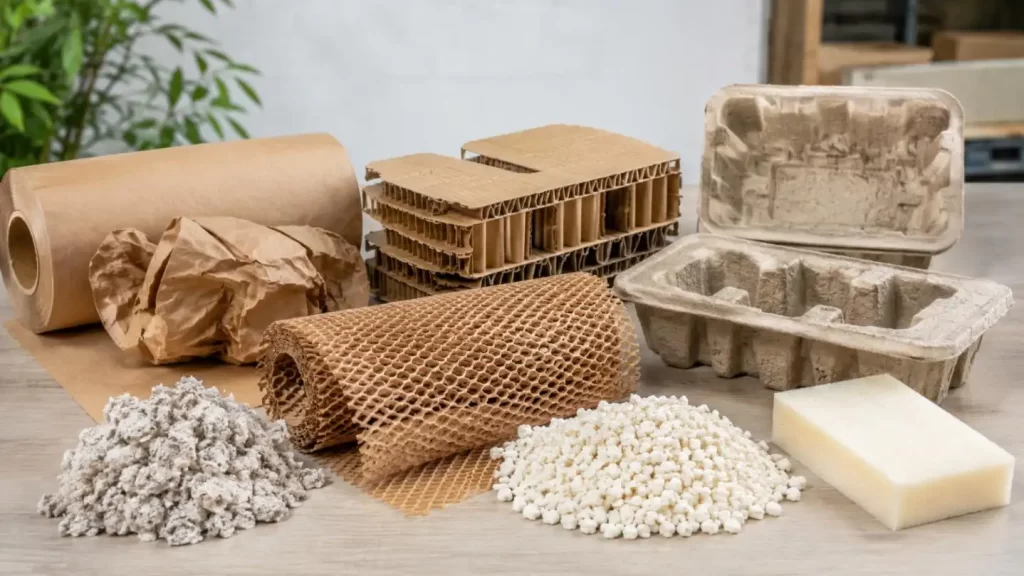
Examples of Best Eco-Friendly Cushioning Materials are molded pulp, honeycomb paper, cellulose padding, paper inserts, recycled paper, starch-based loose fill, and select foams. No single material works for every shipment. The product weight, its level of fragility, moisture exposure, transport distance, and the disposal infrastructure in the final destination all need to be considered.
What Makes a Cushioning Material Eco-Friendly?
Defining a material as eco-friendly is often done by associating adjectives like recyclable, biodegradable, or compostable to it. However, these terms do not equate to lower harm to the environment.
Other factors to be evaluated include:
•Source: Material type and whether it is sourced from a renewable resource
•Cushioning system balance: The cushioning system should use the least amount of material needed in order to protect the product and avoid loss from product breakage and returns.
•Volume and weight of the shipping package: Could the system absorb the weight of the product and the volume of the shipping package?
•End-of-life: The ease of disposal of the cushioning system and the actual disposal options available to the final consumer.
An eco-friendly cushioning material system should protect the product while using only the lowest amount of materials possible.
Best Eco-Friendly Cushioning Materials Compared
| Material | Key Strength | Main Limitation | Typical Uses |
| Recycled Paper | Flexible and widely recyclable | Can be overused for heavy products | Apparel, books, cosmetics |
| Corrugated Inserts | Strong positioning and compression support | Custom development may be needed | Electronics, bottles, components |
| Molded Pulp | Shape-specific protection | Less flexible for changing SKUs | Glassware, appliances, cosmetics |
| Honeycomb Paper | Lightweight wrapping and surface protection | Limited moisture resistance | Gifts, ceramics, bottles |
| Cellulose Padding | Soft protection for delicate finishes | Performance varies by density | Accessories and coated products |
| Starch-Based Loose Fill | Lightweight void filling | Sensitive to humidity | Irregular lightweight goods |
| Bio-Based Foam | Engineered shock absorption | Cost and disposal routes vary | Fragile, high-value products |
| Reusable Thermal Inserts | Cushioning with insulation | Requires a reuse system | Cold-chain delivery |
1. RP Cushioning
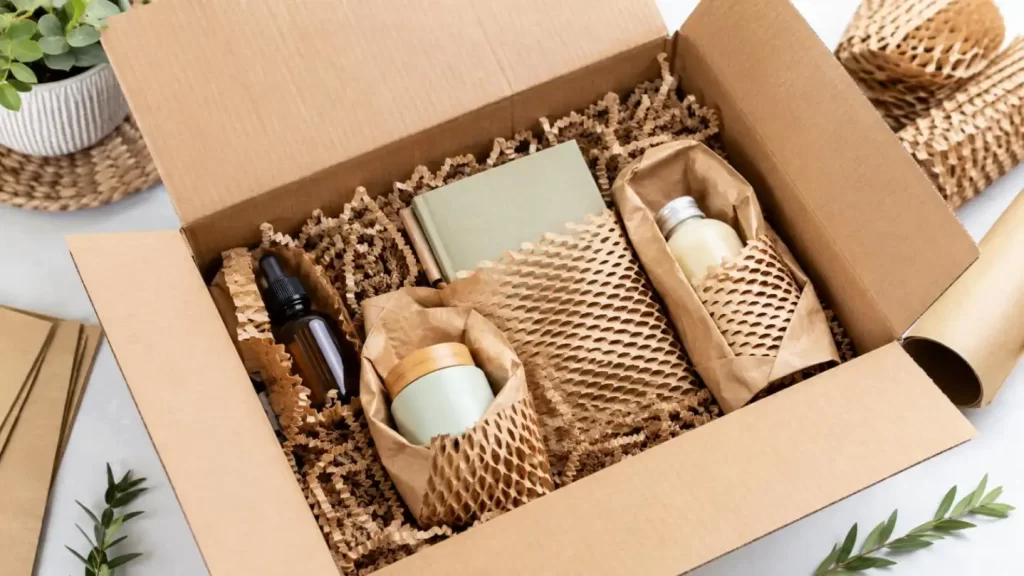
For e-commerce applications, recycled paper is an eco-friendly cushioning material that can come in multiple formats like crinkle paper, kraft paper, tissue paper, folded pads, and machine-formed void fill.
Paper can cushion and protect products, separate them and fill empty space in a carton. It can also form corner pads. It is most effective with apparel, small cosmetic products, books, and small household items.
Paper should be used in moderation and combined with structural supports for fragile products and for heavy-weight products
2. Corrugated Cardboard Inserts
For corrugated boards, parts can be made into separators, frame inserts, edge protectors and product inserts to limit movement and void fill.
Advantages:
•Limited movement and edge protection
•Low compression
•Packing several products
•Easy splitting when combined with paper cartons
3. Molded Pulp Cushioning
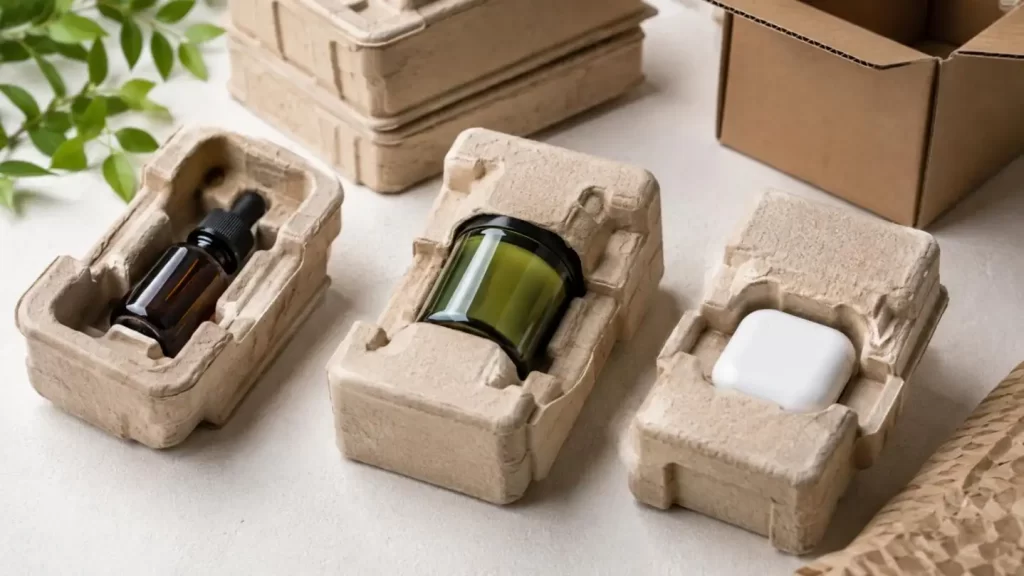
Molded pulp cushioning can take the shape of end caps, trays and inserts to support separation and give a presentation that is consistent and clean. It is best suited for products of stable size and repeated orders, as the inserts are designed specifically for the product and therefore may not fit other similar products.
4. Honeycomb Paper and Cellulose Wraps
Honeycomb paper can cushion products lightly and form a mesh that holds products. Cellulose wraps and fiber pads are used for scratch prevention, product separation and surface-damage prevention.
Honeycomb paper is useful for bottles, ceramics, cosmetics, and presents. However, it may not have the same shock absorption as bubble wrap. Some products still need tested structural cushioning, even if they're fragile.
5. Starch Based Loose Fill
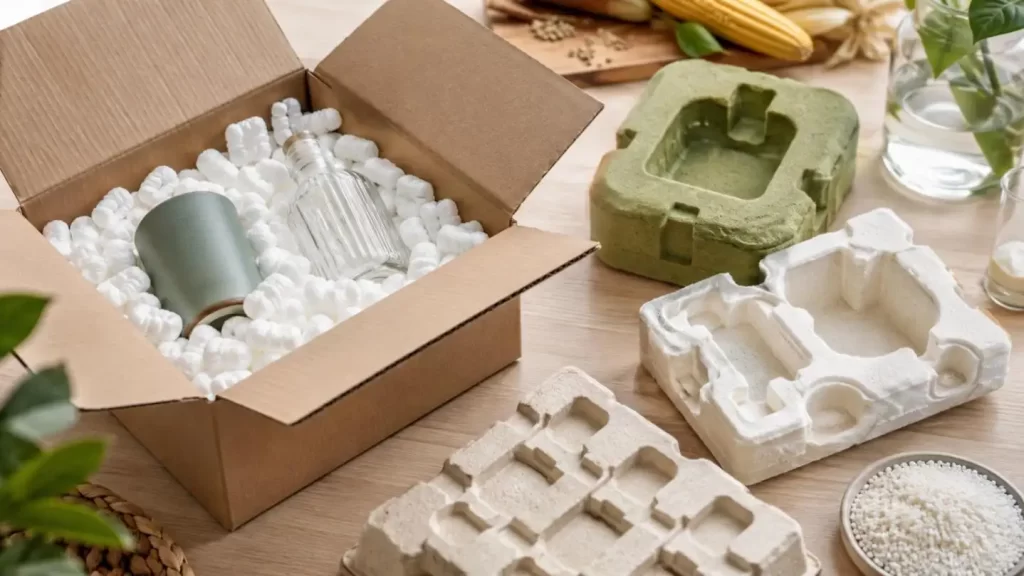
It is made of corn or potato compared to animal by-products and is a good substitute for packing peanuts. It is flexible enough to surround oddly shaped products and rigid inserts. Unlike most other materials, it can be disposed of with the local biodegradable waste.
Before purchasing, verify:
•Home or industrial compostability
•Humidity and storage requirements
•Compression performance during long shipments
•Dust or residue levels
•Disposal instructions for each market
"Bio-based" describes material origin; it does not automatically mean compostable under household conditions.
6. Bio-Based Foams and New Materials
Options such as plant-fiber foams and composites with PLA and starch, mycelium, seaweed, and agricultural-waste fiber materials are on the horizon. They may appear on the list of the Best Eco-Friendly Cushioning Materials in the future, but all of these materials are at different levels of commercial viability.
When considering these materials, buyers should evaluate the ability to manufacture the materials, performance in application, moisture absorption, compatibility with existing equipment, certification, lead time, and available fields of disposal. The innovation of a material should be assessed on the measurable performance of that specific material, not the origin of that material.
Selecting the Best Eco-Friendly Cushioning Materials
Evaluate Product Vulnerability
Determine whether the product may crack, dent, scratch, bend, leak, or form loose components.
Assess Weight and Geometry
Load-bearing structures are needed for heavy products, and flexibility may be needed for irregularly shaped products.
Evaluate Distribution Risks
Consider the shipping environment and the potential for drops, vibration, moisture, temperature changes, stacking pressure, and repeated sorting.
Consider the Outer Package
Less mixed-material combinations usually mean better disposal.
Evaluate End-of-Life Promises
Actual disposal should match claimed disposal.
Assess the Complete Package
Trial-shipment testing and other performance tests of the entire packaging system are necessary to validate the complete package.
Choosing the Best Eco-Friendly Cushioning Materials for Your Packaging
The ideal eco-friendly cushioning materials prevent product damage, minimize the use of materials, and offer a viable solution at end-of-life. Consider the following questions prior to approval:
•Does the packaging avoid product damage for the intended shipping conditions?
•Is the cushioning volume warranted from a technical standpoint?
•Is the cushioning material easy for the recipient to reuse, recycle, compost, or correctly dispose of?
Consider the outer mailers along with their dimensions and sealing methods, the risks during the handling of the package, and the requirements of the package destination as a single packaging system.
GT Group's Development of More Responsible Protective Packaging
Founded in Hong Kong, Gaote Group Co., Ltd. manufactures mailing envelopes, insulated cooler bags, and thermal insulation products with its headquarters in Dongguan, Guangdong.
GT Group supports consistent performance with its film blowing, laminating, slitting, printing, bag converting, and quality testing systems.
Get in touch with GT Group to discuss the configuration of packaging solutions that ensure product protection with a responsible manufacturing process and a caring approach to the environment.
Sustainable Solutions for a Greener Future
High-Capacity Manufacturing with Global Standards
FAQs
Q1. What are the Best Eco-Friendly Cushioning Materials for shipping?
Some of the Best Eco-Friendly Cushioning Materials include Recycled Paper, corrugated inserts, molded pulp, honeycomb paper, cellulose padding, starch based loose fill, and selected bio-based foams. The best option varies based on the weight, fragility, exposure to moisture, and the disposal options available.
Q2. Does GT GROUP manufacture sustainable packaging products?
Yes. GT GROUP manufactures its own mailing envelopes and insulated cooler bags for their clients. They strive to ensure the performance of their products while controlling waste and practicing responsible manufacturing.
Q3. Can GT GROUP help customers choose a protective packaging structure?
Yes. GT GROUP can help choose packaging structures based on the dimensions of the product, the required level of protection, the method of sealing, shipping conditions, and the target markets. The final material choice should also consider the performance of the cushioning and the local disposal options.
Q4. Where is GT GROUP located?
GT GROUP was founded in Hong Kong and is based in Dongguan, Guangdong, China. The manufacturing location supports the production of mailing, insulated, and thermal packaging products.
Q5. What manufacturing capabilities does GT GROUP have?
GT GROUP's facility features film-blowing, laminating, slitting, printing, bag-converting, and quality-testing systems. These capabilities allow it to produce controlled, quality consistent packaging for shipping.
Share on Social:


