


Custom Mailer MOQ, Sample Cost and Production Lead Time: A Buyer’s Guide


There is no single answer that applies to every mailer. Printing a logo on a stock-size bag is very different from manufacturing a new size with custom film, a special closure and full-surface printing. The first option may start in the low hundreds and move quickly. The second may require tooling, material production and a much larger order.
This guide explains how MOQ, sampling and lead time work, what affects each one, and what information to send a manufacturer for an accurate quotation.
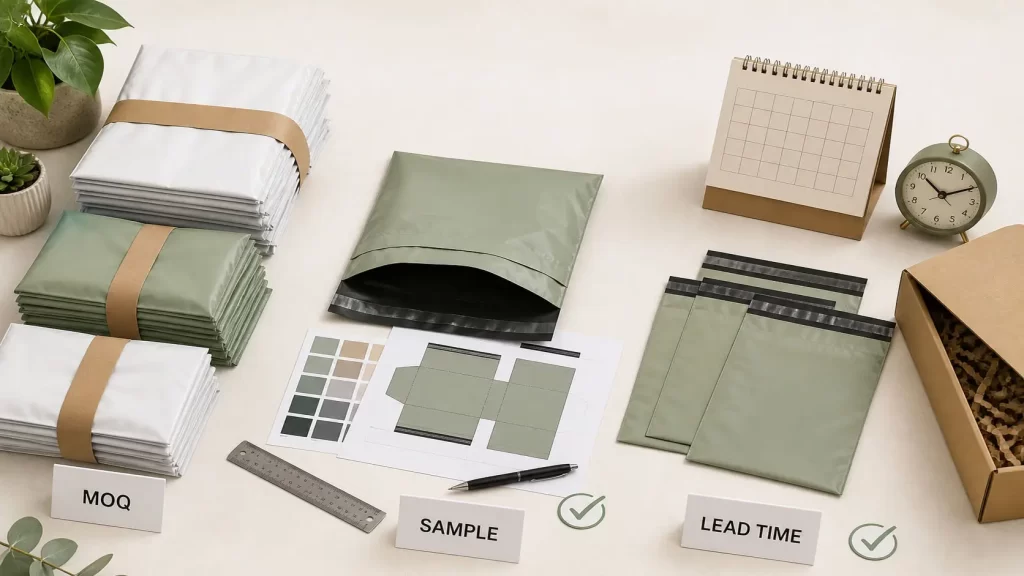
Quick Answer
For planning purposes, custom mailer projects generally fall into four paths:
| Customization route | Approximate MOQ pattern | Sample approach | Production pattern |
|---|---|---|---|
| Plain, stock-size mailer | Lowest | Existing stock sample | Fastest; product may already be available |
| Stock size with logo printing | Low hundreds may be possible | Digital proof plus existing material sample | Often the quickest custom route |
| Digitally printed short run | Hundreds to low thousands, depending on supplier | Digital proof; printed prototype may be available | Shorter setup, but higher unit cost |
| Fully custom size, film or flexographic/gravure print | Usually thousands or more | Dieline, material sample and optional production-equivalent sample | Longer because tooling, film and printing must be prepared |
These are planning categories, not universal price promises. Current supplier offerings show how widely minimums can vary: some advertise 100–500-unit custom poly mailer programs, while another separates a 150-piece short-run program from a 5,000-piece production run. The correct MOQ depends on the exact size, material, print method and construction—not only the words “custom mailer.”
For MailersFactory specifically, the current published offer is MOQ 100 pieces for adding a logo to current-inventory products, with stated delivery in 7–15 days. A fully custom size, film structure or special feature must be quoted separately.
What Does MOQ Mean for Custom Mailers?
MOQ means minimum order quantity: the smallest production quantity a supplier is willing or technically able to make for one specification.
For a custom mailer, one specification normally means the same:
- mailer style;
- finished size and flap depth;
- film or paper structure;
- thickness;
- base color;
- artwork version;
- print colors and coverage;
- closure or return-strip configuration.
If an order contains two sizes or two artwork versions, the quantity usually cannot be combined automatically to meet one MOQ. For example, 500 small mailers and 500 large mailers may be treated as two separate 500-piece items, not one 1,000-piece production run. Ask whether the supplier can gang artwork or combine material purchasing across sizes.
Why Custom Mailer MOQs Vary So Much
MOQ is mainly a manufacturing question. It reflects the amount of material, setup time and machine capacity needed to produce the order efficiently.
1. Stock Size Versus Custom Size
A stock-size mailer is already designed and may already be manufactured. The supplier only needs to print or label it, so the MOQ can be relatively low.
A custom-size mailer may require a new dieline, film layout, cutting settings, seals and tooling. If the width is unique, the factory may also need to produce a dedicated film roll. That raises both the practical minimum and setup cost.
2. Digital Printing Versus Flexographic or Gravure Printing
Digital printing normally has less physical setup. It is useful for launches, seasonal artwork, influencer kits and demand testing. It can support smaller quantities, but the unit price may remain higher as volume grows.
Flexographic and gravure printing are designed for efficient repeat production. They can provide strong color consistency and competitive unit economics at scale, but plates or cylinders, ink setup and machine makeready must be justified across a larger quantity.
3. Standard Film Versus Custom Film
Standard white, gray or black polyethylene film is easier to source in small quantities. A custom-colored film, a special co-extruded structure, high recycled content, compostable material, metallic finish or barrier laminate may have its own raw-material minimum.
In some projects, the material supplier’s minimum—not the mailer converter’s machine capacity—sets the final MOQ.
4. Print Coverage and Number of Colors
A small one-color logo is usually simpler than photographic graphics, edge-to-edge coverage, exact Pantone matching or printing on both sides. More colors can mean more plates, more setup and additional registration control.
5. Special Features
The following features may change the MOQ:
- two adhesive strips for returns;
- tear strip or perforation;
- zipper closure;
- bubble, foam or paper padding;
- custom handles or vents;
- tamper-evident construction;
- matte, gloss or metallic finish;
- special regulatory warning text;
- variable data, QR codes or multiple artwork versions.
How to Choose the Right MOQ Route
The lowest MOQ is not automatically the lowest-cost decision. Select a route based on what the order must prove.
| Business goal | Best starting route | Why |
|---|---|---|
| Test a new brand or product | Stock size plus simple print or digital short run | Limits inventory risk and speeds up launch |
| Validate size and packing process | Plain stock mailers in two or three sizes | Tests fit before paying for print or tooling |
| Create a unique branded experience | Fully custom size and print | Provides better fit and visual control |
| Reduce unit cost on a proven SKU | Production-scale flexographic or gravure run | Spreads setup cost across more units |
| Launch a specialty sustainable mailer | Material sample and compliance review first | Confirms feel, performance and claim language before volume production |
If the product has not yet shipped at scale, test the size before committing to a large printed run. A low-cost plain mailer can reveal overstuffing, seal failure, excess empty space or unexpected dimensional weight.
What Does a Custom Mailer Sample Cost?
“Sample” can mean five different things. Always specify which one you need before comparing quotations.
| Sample type | What it confirms | Typical charge model | What it does not confirm |
|---|---|---|---|
| Digital mockup | Logo position, layout and basic appearance | Commonly included with quotation or order | Material feel, exact color and construction |
| Existing stock sample | Film, paper, thickness, seal and general print quality | May be free; courier cost may apply | Your exact size and artwork |
| Blank custom-size prototype | Fit, dimensions, flap and packing process | Quoted according to tooling and handwork | Final print color and production consistency |
| Digitally printed prototype | Artwork scale and an approximate finished appearance | Quoted per project | Exact match to flexographic or gravure production |
| Production-equivalent sample | Final material, print method and construction | Highest sample cost; may require plates, cylinders or a minimum machine run | Mass-production variation across the entire run |
MailersFactory states that existing samples are available free for material and printing-effect confirmation. Buyers should still confirm sample eligibility, courier charges, taxes or duties and whether a custom printed sample is included.
Why a Production Sample Can Cost Much More Than One Bag
You are not paying for one mailer. You are paying for the setup required to make it:
- artwork checking and prepress;
- dieline preparation;
- printing plates or cylinders;
- material and ink setup;
- machine makeready and waste;
- lamination or curing time;
- cutting, sealing and inspection;
- international courier service.
A production-equivalent sample may therefore be uneconomical for a very small order. In that case, a digital proof plus an existing material sample may provide enough confidence.
Ask These Questions About the Sample Fee
Before approving a sample invoice, ask:
- Is this an existing sample, a custom-size blank or a fully printed production sample?
- Will the sample use the same material, thickness and print process as mass production?
- Are plates, cylinders, molds or dies included?
- How many revisions are included?
- Is express courier shipping included?
- Can any part of the fee be credited against the production order?
- Will the tooling remain available for reorders, and for how long?
These questions make supplier comparisons much more accurate than comparing a single “sample cost” number.
Digital Proof Versus Physical Sample
A digital proof is usually sufficient when:
- you are printing a simple logo on a previously approved stock mailer;
- the dimensions and material have already been tested;
- the artwork uses uncomplicated colors;
- speed is more important than a physical preproduction sample.
A physical sample is strongly recommended when:
- the size is new;
- the packed product is bulky, sharp or heavy;
- exact brand color matters;
- the artwork crosses seals, folds or gussets;
- a new adhesive or return strip is being used;
- the film is recycled, compostable or otherwise unfamiliar;
- the order quantity or financial risk is high.
For color-critical work, request a physical color standard or approved Pantone reference. Screen colors are affected by the monitor, file profile, lighting, base film and ink opacity; a digital PDF cannot guarantee the final printed result.
How Long Do Custom Mailers Take?
“Lead time” must be defined before it can be compared. Some suppliers quote production time only. Others quote from approved artwork to shipment. Neither necessarily includes sampling, international transit, customs clearance or delivery to your warehouse.
A custom mailer project usually moves through this sequence:
Specification → quotation → artwork/dieline → proof → sample if required → approval and deposit → material preparation → printing → lamination/curing if required → bag making → quality inspection → packing → shipment
Practical Planning Timeline
| Stage | Planning allowance | Main variables |
|---|---|---|
| Specification and quotation | 1–3 business days | Completeness of RFQ, unusual materials, multiple quantities |
| Dieline and digital proof | 1–3 business days per round | Artwork quality, revisions, color requirements |
| Existing sample dispatch | 1–3 business days plus transit | Sample availability and courier destination |
| Custom prototype | Several business days to two weeks or more | Tooling, material, print process and revisions |
| Stock-size logo production | Often around 1–3 weeks | Print method, capacity and artwork approval |
| Fully custom production | Often several weeks | Film production, tooling, number of colors, curing and quantity |
| Shipping | Separate from production | Express, air or sea freight, destination and customs |
These allowances are for scheduling, not a guaranteed quotation. For context, current market offers range from production beginning at about seven business days to 10–14-day programs for certain custom poly mailers. MailersFactory currently states 7–15-day delivery for logo customization on current-inventory products. Custom structures should be confirmed against the actual specification and destination.
When Does the Production Clock Start?
Production usually starts only after all commercial and technical approvals are complete. Confirm the official start date in writing. It may require:
- approved quotation or purchase order;
- deposit received;
- final dimensions and material confirmed;
- print-ready artwork received;
- digital proof or physical sample approved;
- shipping marks and packing requirements confirmed.
If artwork approval is delayed by five days, the delivery date usually moves by at least five days. A target date mentioned during the first inquiry is not automatically reserved production capacity.
What Can Extend Production Lead Time?
Artwork Revisions
Low-resolution logos, missing fonts, incorrect bleed, unclear spot colors or late text changes stop prepress. Supply vector artwork in AI, EPS or editable PDF format, with fonts outlined and colors specified.
Custom Film or Material
A nonstandard thickness, base color, recycled-content percentage or multilayer structure may need a dedicated raw-material run. Material availability should be confirmed before the final schedule is promised.
Plates, Cylinders and Tooling
New print plates, gravure cylinders, dies or sealing tools add preparation time. Reorders may be faster if the artwork and tooling remain unchanged and usable.
Lamination and Curing
Some bubble mailers and composite films require lamination. Adhesives and inks may need curing time before the material can be converted or tested safely.
Multiple SKUs
Changing size, color or artwork between SKUs creates extra setups. A factory may run the products sequentially, so the final SKU—not the first one—determines the shipment date.
Peak Season and Holidays
Capacity tightens before major ecommerce events and factory holidays. Place seasonal orders early and approve artwork promptly. If a launch date is immovable, tell the supplier during the first quotation—not after production begins.
Inspection and Testing
Third-party inspections, migration tests, compostability documentation, recycled-content verification or retailer-specific tests can add time. Treat certification review as part of the project plan rather than an after-production task.
How MOQ, Sample Cost and Lead Time Affect One Another
The three variables are connected.
- Lower MOQ: often means using a stock size or digital printing, with a higher unit price.
- Lowest unit cost: often requires a larger production run and accepting more inventory.
- Exact production sample: improves confidence but adds cost and time before mass production.
- Fastest delivery: usually requires standard material, stock size, simple artwork and prompt approval.
- Most customization: may require tooling, higher MOQ and a longer schedule.
The best quotation is therefore not always the one with the lowest price per bag. Calculate the total landed and inventory cost:
Total project cost = mailers + setup/tooling + samples + freight + duties/taxes + storage + obsolete-inventory risk
A higher unit price on 500 mailers can be less expensive than buying 5,000 units that become obsolete after a logo, product or compliance change.
How to Request an Accurate Custom Mailer Quote
Send one complete RFQ instead of asking only, “What is your MOQ?” Include:
- Mailer type: poly mailer, bubble mailer, paper mailer, compostable mailer or another style;
- Usable internal size: width × length, excluding the closure flap;
- Packed product: dimensions, weight, shape and whether it has sharp edges;
- Material: LDPE, co-extruded film, recycled-content film, compostable film, kraft paper or other structure;
- Thickness: in mil or microns, with the measurement convention stated;
- Quantity: request price breaks such as 500, 1,000, 3,000, 5,000 and 10,000;
- Printing: number of sides, colors, Pantone references and approximate coverage;
- Features: one or two adhesive strips, tear strip, zipper, gusset, padding, vents or warning text;
- Artwork: vector file plus a visual reference;
- Sample requirement: existing material sample, blank size sample or production-equivalent printed sample;
- Destination: city, postal code and country;
- Trade term: EXW, FOB, DDP or another required term;
- Required arrival date: not only the desired ship date;
- Quality or sustainability requirements: testing, certification and inspection needs.
Also ask the supplier to separate the quotation into unit price, one-time setup or tooling, sample charge, freight, tax/duty assumptions and estimated production time after approval.
A Simple Buyer Example
Imagine an apparel brand needs branded mailers for a new product launch.
The brand expects 300 orders in the first month but may change its artwork after customer feedback. Ordering a large fully custom run may produce the lowest unit price, yet create unnecessary inventory risk. A stock-size, low-MOQ printed mailer is likely the better first step.
After the fit, artwork and monthly demand are proven, the brand can move to a larger production run, add a custom size and negotiate better unit pricing. The first order validates the specification; the second order optimizes economics.
For a mature SKU shipping 20,000 units per quarter, the decision changes. Tooling and a higher MOQ may be justified because the setup cost is distributed across repeat volume, storage planning is predictable and custom sizing may reduce material and freight costs.
How to Reduce MOQ, Sample Expense and Delays
- Choose a standard size whenever it fits the packed product safely.
- Limit the first design to one side or fewer spot colors.
- Use a standard base film instead of a custom film color.
- Approve the material with an existing sample before ordering a printed prototype.
- Test fit with an unprinted sample.
- Prepare print-ready vector artwork before requesting the final schedule.
- Consolidate revisions into one proof round.
- Request several quantity tiers to see where the price drops materially.
- Forecast reorders and retain approved specifications, Pantone references and tooling records.
- Build freight, customs and a reasonable contingency into the launch calendar.
Frequently Asked Questions
What is the minimum order for custom mailers?
It depends on the customization method. Stock-size logo printing may be available in the low hundreds, while custom size, film and production printing often require thousands. MailersFactory currently advertises an MOQ of 100 pieces specifically for logo customization on current-inventory products. Request a separate MOQ for each size, material and artwork version.
Can I order one custom mailer sample?
Often, yes, but confirm what “custom” means. A single hand-made or digitally printed prototype may not use the same process as mass production. A production-equivalent sample can require plates, cylinders, material setup or a small machine run, making it much more expensive.
Are custom mailer samples free?
Existing stock samples may be free from some manufacturers, although courier charges can apply. A custom-size or custom-printed sample is usually quoted according to the required materials, tooling and production method. MailersFactory states that it offers free existing samples for checking materials and printing effects.
Is the sample fee refundable?
Some suppliers credit part of the sample or tooling fee toward a qualifying production order, but this is not universal. Ask for the credit terms, minimum order value and validity period in writing.
How long does a custom mailer sample take?
An existing sample can be dispatched quickly if it is in stock. A custom prototype may take several business days or longer, especially if it requires new tooling, film, printing, lamination or more than one revision. International transit is additional.
How long does custom mailer production take?
Simple stock-size logo projects can take roughly one to three weeks, while fully custom manufacturing often takes several weeks. The schedule normally begins after the deposit, final specification and proof are approved. Shipping and customs may not be included.
Can I split the MOQ across different sizes or designs?
Usually each size and artwork version has its own MOQ because it requires a separate setup. Some suppliers can combine materials or gang artwork, so ask before assuming the quantities can be pooled.
Does a reorder have the same lead time?
A repeat order can be faster when artwork, tooling, material and specifications remain unchanged. However, production capacity and raw-material availability still need confirmation. Keep the approved sample and specification sheet for comparison.
Should I approve a physical sample before production?
Use a physical sample for a new size, unfamiliar material, color-critical design, special closure or high-value order. For a repeat stock-size mailer with a simple logo, an approved digital proof and existing material sample may be sufficient.
Plan Your Custom Mailer Project with MailersFactory
MailersFactory manufactures regular poly mailers, bubble mailers, paper-based packaging and sustainable mailer options. Its current-inventory logo customization program starts at 100 pieces and has a stated 7–15-day delivery window. Fully custom sizes, films, structures and printing processes are quoted according to the project.
To receive an accurate MOQ, sample plan and schedule, send your packed-product dimensions, desired mailer size, material, thickness, quantity, artwork and destination through the custom packaging page or contact MailersFactory.
Ask for three numbers in the reply:
- the MOQ for your exact specification;
- the total sample and one-time tooling cost;
- the production and delivery timeline measured from final approval.
That gives your team a quote it can use for budgeting, inventory planning and a realistic launch date.
Share on Social:


