


How to Choose Poly Mailer Size and Film Thickness


Choosing a poly mailer is not simply a matter of matching the bag to the product’s length and width. The packed product’s thickness, shape, weight, edges and shipping route all affect the size and film construction required.
The quickest practical approach is:
- Pack and fold the product exactly as it will be fulfilled.
- Measure its width, length and total thickness.
- Add the thickness to both mailer dimensions, then add a small packing allowance.
- Select a film thickness based on puncture risk and handling—not product weight alone.
- Test the complete mailer, seams and adhesive closure before ordering in volume.
For many soft ecommerce products, 2.0–3.0 mil film is a reasonable sample-testing range. That is not a universal specification. A well-engineered co-extruded film can perform differently from another film of the same nominal thickness, and a thicker bag can still fail at its seams or closure.
This guide explains how to calculate a starting size, compare mil and micron measurements, select a film construction and write a useful specification for suppliers.
Why Poly Mailer Size Matters
A correctly sized poly mailer should be easy to fill and seal without excessive empty space. The package should hold the product securely while leaving the adhesive strip and seams unstressed.
An undersized mailer can cause:
- Stretched side seams
- Wrinkled or incomplete adhesive contact
- Punctures from product corners
- Difficult packing and slower fulfillment
- Bulging that interferes with label application
- Packages opening during transit
An oversized mailer can cause:
- Unnecessary material use
- Product movement inside the package
- Loose material catching during handling
- A less consistent customer presentation
- Larger final parcel dimensions
- More mailer sizes occupying warehouse space
The goal is not the tightest possible fit. It is the smallest size that employees can pack consistently and that remains secure throughout distribution.
Understand How Mailer Dimensions Are Listed
Poly mailer dimensions are usually presented as width × length. For example, a 10 × 13-inch mailer is approximately 10 inches across the opening and 13 inches from the bottom seam to the top of the usable body.
However, suppliers do not always define dimensions in exactly the same way. Before comparing quotations, confirm:
- Whether the listed length includes the adhesive flap
- Whether dimensions are nominal or minimum usable dimensions
- How much width is lost to side seals
- Whether there is a bottom seal or side-gusset construction
- Whether the measurement is taken with the bag laid flat
- The dimensional tolerance allowed in production
The adhesive flap is generally not usable product space. A supplier may list a “12 × 15.5 + 2-inch flap” configuration, meaning the body is 12 × 15.5 inches and the closure flap adds another 2 inches.
Always request a drawing with the usable body dimensions, flap depth, seal positions, tear strip and second return strip when applicable.
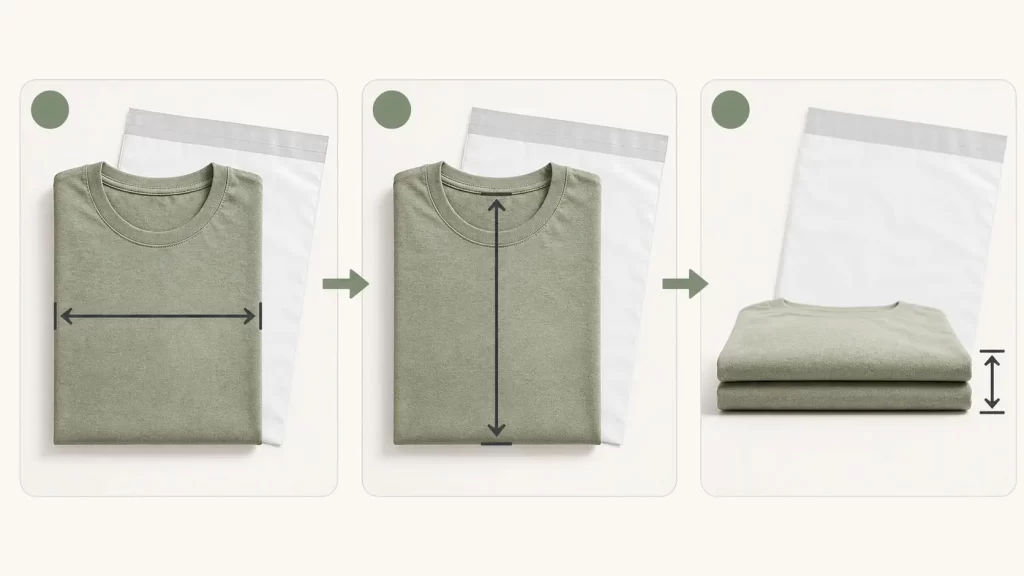
How to Measure the Product
Do not measure the product in its unfolded retail condition. Measure the final packed unit exactly as it will enter the mailer.
Step 1: Prepare a realistic packed sample
Include every component used in fulfillment:
- Folded product
- Tissue paper or inner bag
- Retail carton or insert
- Printed card, invoice or return form
- Protective wrap
- Multipack components
Compress soft products only to the level employees can reproduce safely at the packing station. Do not calculate the size using a tightly compressed sample if normal orders will be packed more loosely.
Step 2: Measure three dimensions
Record:
- W: packed product width across the mailer opening
- L: packed product length from top to bottom
- T: maximum packed thickness or depth
Measure the thickest point. A folded hoodie may be much thicker in the center than at the edges.
Step 3: Check rigid corners and irregular shapes
A rigid retail box, buckle, zipper pull or metal component can create a concentrated pressure point. Measure the complete profile and consider whether that item needs corner protection or a box instead of simply using thicker film.
Poly Mailer Size Formula
For a flat, non-gusseted poly mailer, use the following as a starting estimate:
Minimum mailer width = product width + product thickness + 0.5–1 inch packing allowance
Minimum usable mailer length = product length + product thickness + 1–2 inches packing and sealing allowance
In metric units:
Minimum mailer width = product width + product thickness + approximately 13–25 mm
Minimum usable mailer length = product length + product thickness + approximately 25–50 mm
This is a sampling formula, not a manufacturing guarantee. Film flexibility, product shape, seal width and packing process affect the final fit.
Why thickness is added to both dimensions
A flat bag must expand around the product’s depth. If the product measures 10 inches wide but is 2 inches thick, a 10-inch lay-flat mailer will usually be too narrow because part of the film width is needed to wrap around the sides.
The same principle applies to length. The film must travel around the lower and upper portions of the product while leaving enough clean, unstressed area for the flap to seal.
Size Example 1: Folded T-Shirts
Assume a packed stack of two T-shirts measures:
- Width: 10 inches
- Length: 12 inches
- Thickness: 1.5 inches
Starting width:
10 + 1.5 + 0.5–1 = 12–12.5 inches
Starting usable length:
12 + 1.5 + 1–2 = 14.5–15.5 inches
A mailer with an approximately 12 × 15.5-inch usable body would be a logical first sample. Test the actual product because fabric density, folding method and inner packaging can change the fit.
Check that:
- The T-shirts slide into the bag without excessive force
- The side seams do not stretch white or deform
- The flap lies flat across the full adhesive area
- The final package is smooth enough for a shipping label
- Staff can pack it consistently without compressing every order by hand
Size Example 2: A Folded Hoodie
Assume a folded hoodie measures:
- Width: 12 inches
- Length: 15 inches
- Thickness: 3 inches
Starting width:
12 + 3 + 0.5–1 = 15.5–16 inches
Starting usable length:
15 + 3 + 1–2 = 19–20 inches
A custom 16 × 20-inch body would be a useful starting point. If only stock sizes are available, compare the nearest larger options and confirm that the excess material does not create handling problems.
For compressible garments, test both the normal packing condition and the fullest realistic condition, such as the largest size or thickest fabric in the SKU range.
Common Poly Mailer Sizes and Typical Uses
The following examples are general starting points. Supplier dimensions and product folding methods vary.
| Approximate mailer size | Products often tested in this range |
|---|---|
| 6 × 9 in / 152 × 229 mm | Small fabric accessories, socks, compact parts |
| 7.5 × 10.5 in / 191 × 267 mm | Small apparel items, children’s clothing |
| 9 × 12 in / 229 × 305 mm | One small folded shirt, light accessories |
| 10 × 13 in / 254 × 330 mm | T-shirts, lightweight garments, small soft goods |
| 12 × 15.5 in / 305 × 394 mm | Multiple shirts, light sweaters, medium apparel orders |
| 14 × 17 in / 356 × 432 mm | Hoodies, trousers, larger apparel items |
| 14.5 × 19 in / 368 × 483 mm | Bulkier garments and small multi-item orders |
| 19 × 24 in / 483 × 610 mm | Coats, blankets and larger soft products |
Do not select a size solely from this table. The same “medium hoodie” can vary significantly by fabric weight, fold pattern and retail packaging.
What Does Poly Mailer Film Thickness Mean?
In many markets, poly mailer thickness is expressed in mil. One mil is one-thousandth of an inch:
1 mil = 0.001 inch = 25.4 microns (µm)
This is not the same as one millimeter. A 2.5 mil film is approximately 0.0635 mm or 63.5 microns thick.
| Film thickness | Approximate microns |
|---|---|
| 1.5 mil | 38 µm |
| 2.0 mil | 51 µm |
| 2.5 mil | 64 µm |
| 3.0 mil | 76 µm |
| 3.5 mil | 89 µm |
| 4.0 mil | 102 µm |
| 5.0 mil | 127 µm |
When requesting a quotation, confirm whether the thickness describes a single film wall or the combined thickness of both sides of the finished bag. For many poly bag specifications, the stated gauge refers to a single wall, but the purchasing document should make this explicit.
Also request the production tolerance and measurement method. ASTM D6988 provides guidance for determining the thickness of plastic film test specimens, but commercial specifications still need an agreed sampling and acceptance process.
Poly Mailer Thickness Guide
Use this table to select samples—not to skip performance testing.
| Nominal film thickness | Suggested sample applications | Important limitations |
|---|---|---|
| 1.5–2.0 mil / 38–51 µm | Very light soft goods, inner bags or controlled low-abuse distribution | May provide limited puncture resistance for outer parcel shipping |
| 2.0–2.5 mil / 51–64 µm | T-shirts, socks and other lightweight non-fragile products | Test seams and puncture resistance for rigid components |
| 2.5–3.0 mil / 64–76 µm | General ecommerce apparel, hoodies and small multi-item soft-good orders | Still offers no cushioning or compression protection |
| 3.0–4.0 mil / 76–102 µm | Heavier garments, demanding routes, light retail boxes without sharp corners, return-ready mailers | A box may still be required for rigid, valuable or crushable products |
| 4.0 mil+ / 102 µm+ | High-abuse applications or heavier non-fragile items after testing | Higher gauge increases material and may not solve weak seals or sharp-edge failures |
If the product is fragile, crushable, sharp or heavy, moving to thicker film may be the wrong solution. Consider a bubble mailer, rigid mailer or corrugated box.
Why Thickness Alone Does Not Predict Strength
Two mailers marked “2.5 mil” can perform differently. Thickness is only one part of the film specification.
Performance can also depend on:
- Resin selection, including LDPE and LLDPE blends
- Co-extruded layer structure
- Machine-direction and transverse-direction orientation
- Recycled-content percentage and consistency
- Pigments, fillers and additives
- Film uniformity
- Surface treatment for printing
- Side- and bottom-seal design
- Adhesive formulation and application
- Perforation and return-strip geometry
- Printing coverage
ASTM D1709 notes that plastic-film impact resistance has no simple correlation with thickness. Film quality, fabrication method and other variables influence the result. This is why buyers should compare supplier test data and finished-mailer trials rather than selecting on gauge alone.
Match Thickness to the Product Risk
Softness and compressibility
Soft apparel can absorb normal pressure without breaking, so it often needs less film strength than a rigid object of the same weight.
Corners and protrusions
Books, retail cartons, buckles and components with corners create local stress. A mailer can puncture where the product presses against one small area even when its total weight is low.
Shipment weight
Heavier products place more load on the bottom and side seams. However, increasing film thickness does not automatically strengthen the heat seals or adhesive closure.
Shipping distance and handling
Longer or multi-carrier routes may involve more sorting, transfers and surface abrasion. Test the actual distribution route when possible.
Returns
A return-ready mailer needs enough durability for the outbound shipment, customer opening and return journey. Specify two adhesive strips and a controlled tear strip, then test the opened package before assuming it is reusable.
Product value
The financial risk of damage can justify a stronger mailer or a more protective packaging format. Consider replacement cost, reshipping, customer service and brand impact—not only packaging price.
Material and Construction Options
Mono-layer film
A single-layer film may be suitable for straightforward applications and can offer simple construction. Performance depends heavily on the selected resin and manufacturing control.
Co-extruded film
Co-extrusion allows multiple layers to perform different functions. A mailer might combine an exterior layer optimized for printing, a strength layer and an opaque interior layer for privacy.
Ask for the total gauge, layer structure and performance data rather than assuming that “co-extruded” automatically means stronger.
Recycled-content film
Post-consumer recycled content can reduce the use of virgin material, but percentage alone does not define mailer performance. Verify the source and claimed percentage, then test seal consistency, puncture resistance, color uniformity and odor for the intended application.
Avoid solving every performance concern by increasing thickness. A better resin blend or package design may achieve the required result with less material.
What Performance Data Should Buyers Request?
Thickness should be supported by relevant performance information. Depending on the application, ask about:
- Film thickness and tolerance
- Tensile strength and elongation
- Dart-drop impact resistance
- Tear-propagation resistance
- Puncture resistance
- Side- and bottom-seal strength
- Adhesive closure strength
- Coefficient of friction for packing and conveyor handling
- Opacity and light transmission
- Moisture resistance
- Print adhesion and rub resistance
Common test references include ASTM D882 for tensile properties of thin plastic sheeting, ASTM D1709 for free-falling dart impact resistance, ASTM D1922 for propagation tear resistance and ASTM F88/F88M for seal strength of flexible barrier materials.
Test values should identify the method, film thickness, sample direction and testing conditions. A single number without that context may not allow a meaningful comparison.
How to Test a Poly Mailer Before Ordering
1. Fit test
Pack the smallest, largest and thickest SKUs intended for that mailer. Confirm that employees can insert and remove products without stretching the seams.
2. Closure test
Seal the mailer under normal packing-room conditions. Check the full adhesive width and verify that dust, fabric fibers or wrinkles do not prevent contact.
3. Puncture and edge test
Press and move the packed product against the mailer’s surfaces and corners. Look for whitening, thinning or sharp pressure points.
4. Drop and handling test
Test packed samples under conditions representative of the distribution route. Fragile, liquid or regulated contents may require specific carrier rules or formal test procedures.
USPS, for example, requires mailpieces to withstand normal transit and handling without content or package breakage. Carrier requirements differ, so check every service used by the business.
5. Label and scan test
Apply the actual shipping label to a packed mailer. Ensure the surface stays flat enough for barcode scanning and that the label remains attached after bending and rubbing.
6. Packing-line test
Ask multiple employees to pack a trial batch. Record filling time, sealing errors and ergonomic problems. A size that works for one carefully prepared sample may be inefficient at production speed.
7. Live shipping pilot
Ship a limited batch through normal carriers and destinations. Record package condition, product damage, opening experience and returns before approving a large production run.
Common Sizing and Thickness Mistakes
Measuring only the product width and length
Ignoring product thickness is one of the most common reasons a selected mailer is too small.
Counting the flap as usable space
The adhesive flap must fold over cleanly. Do not fill the package into the closure area.
Choosing one size for every SKU
One universal size may simplify inventory but waste material and create poor fit for the smallest orders. Group SKUs by packed dimensions and order profile.
Choosing film based only on product weight
A light product with a sharp corner can be more demanding than a heavier soft product.
Assuming thicker always means stronger
Film formulation, thickness uniformity, seams and closure design are equally important.
Skipping the printed-sample test
Production printing, surface treatment and converting may affect the final mailer. Approve a finished printed sample rather than relying only on unprinted film.
Ignoring gauge tolerance
“2.5 mil nominal” does not mean every measured point will be exactly 2.5 mil. Put the acceptable thickness range and sampling method in the specification.
Example Poly Mailer Purchasing Specification
A useful supplier request might include:
Custom poly mailer with 12 × 15.5-inch minimum usable body, excluding flap; 2-inch adhesive flap; 2.5 mil nominal single-wall co-extruded polyethylene film; agreed gauge tolerance; white printable exterior and opaque gray interior; permanent self-seal closure; side-seal and adhesive-strength requirements; one-color exterior printing; packed in labeled cartons. Supplier to provide material specification, dimension drawing, unprinted fit samples, printed approval sample and available test results.
For a return-ready version, add:
- Two adhesive strips
- Tear-strip position
- Perforation dimensions
- Required space between outbound and return seals
- Test requirement after the first opening
Do not copy this example without adapting it to the product, regulations, carrier and destination market.
Final Recommendation
To choose the right poly mailer size:
- Measure the fully packed product.
- Add product thickness to both width and length.
- Add a modest packing and sealing allowance.
- Confirm usable dimensions exclude the flap and account for seams.
- Approve the size with real packing-line samples.
To choose the right film thickness:
- Start with the product’s puncture, edge and handling risks.
- Use 2.0–3.0 mil only as a common sample range for soft ecommerce goods—not as a universal rule.
- Compare resin formulation, co-extrusion, seams and closure performance.
- Request relevant test data with method and conditions.
- Run a live shipping pilot before volume production.
The correct mailer is the lightest, smallest construction that consistently protects the product through packing, shipping, delivery and any intended return journey.
MailersFactory supplies regular poly mailers and custom sizes, printing and material options for ecommerce shipping. Use our custom packaging service or contact MailersFactory with your packed product dimensions, order quantity, destination and required performance so the team can recommend samples for testing.
Frequently Asked Questions
What size poly mailer do I need for a T-shirt?
It depends on the shirt size, fabric and folding method. A 9 × 12-inch or 10 × 13-inch mailer may work for one lightweight folded shirt, while larger or multiple shirts may require approximately 12 × 15.5 inches. Measure the packed stack and test samples before ordering.
What size poly mailer should I use for a hoodie?
Many folded hoodies need a size around 14 × 17 inches or larger. Heavy fabric and larger garment sizes may need 14.5 × 19 inches, 16 × 20 inches or another custom size. Add the folded thickness to both dimensions when calculating the fit.
Is a 2.5 mil poly mailer thick enough?
It is a common starting thickness for apparel and other non-fragile ecommerce products, but suitability depends on the resin, film structure, seams, product edges and distribution route. Test the complete package.
Is 3 mil stronger than 2.5 mil?
It contains more film when the material and construction are otherwise identical, but thickness alone does not guarantee higher overall performance. Resin formulation, orientation, gauge consistency and seal quality can change the result.
How many microns is a 2.5 mil mailer?
Approximately 63.5 microns. One mil equals 25.4 microns.
Does poly mailer length include the flap?
It depends on the supplier. Some list body dimensions separately from the flap, while others may show overall dimensions. Request minimum usable body dimensions and a technical drawing.
Should a poly mailer fit tightly?
It should fit closely without stretching the seams or closure. Employees should be able to insert the product easily, and the adhesive flap should lie flat across the full sealing area.
Can I use thicker poly mailers for fragile products?
Thicker film may improve resistance to some puncture and handling risks, but it does not provide cushioning or compression protection. Fragile products may need bubble mailers, rigid mailers or corrugated boxes with appropriate cushioning.
Share on Social:


