


Cross-Linked Polyethylene Foam Insulation for Frozen Food Shipping


Shipping frozen food requires careful control of temperature gain during the entire packaging, shipping, and last-mile delivery processes. Changes in external temperature, poorly sealed seams, insufficient or inappropriate refrigerants, and poor space utilization all can cause a temperature spike in the frozen food being transported.
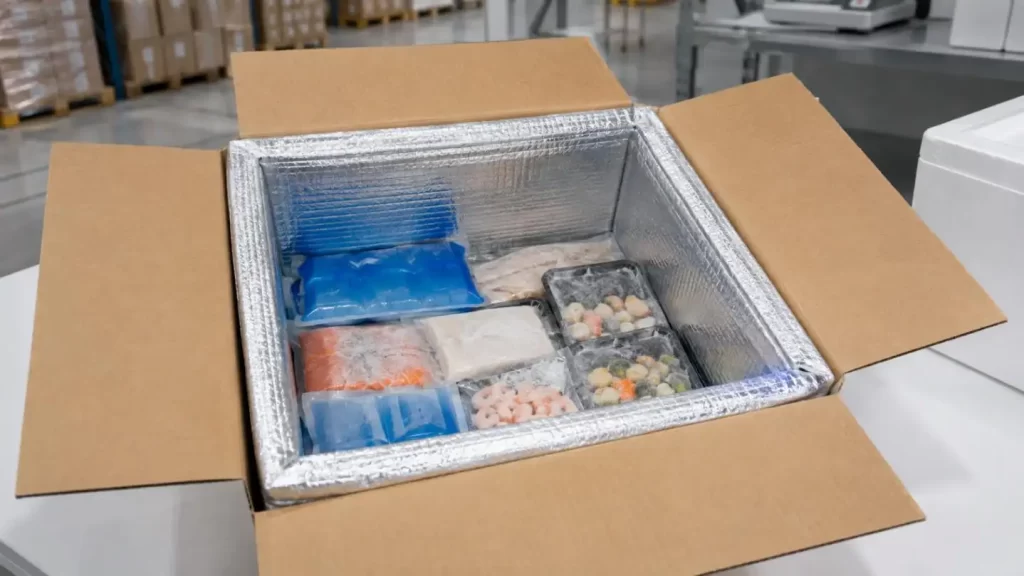
Cross-Linked Polyethylene Foam Insulation is an excellent example of a material used to line thermal bags and box liners. It is closed-cell, limits moisture uptake, and provides a smooth, clean, flexible interior surface.
However, Cross-Linked Polyethylene Foam Insulation is not a cooling source. It must be combined with suitable gel packs, frozen bricks, dry ice or another refrigerant system selected for the product and shipping route.
What Is Cross-Linked Polyethylene Foam Insulation?
Cross-Linked Polyethylene Foam Insulation (XLPE foam insulation) is made by cross-linking the polyethylene structure. During the manufacturing process, the material forms many small closed cells that capture air and limit moisture transfer.
As a result, Cross-Linked Polyethylene Foam Insulation is effective in temperature-sensitive package applications because of the following:
•Low absorption of moisture
•Easily formable sheets
•Excellent stability of dimensions
•Recovers from compression
•Surfaces are clean and smooth
•Adheres easily to other materials
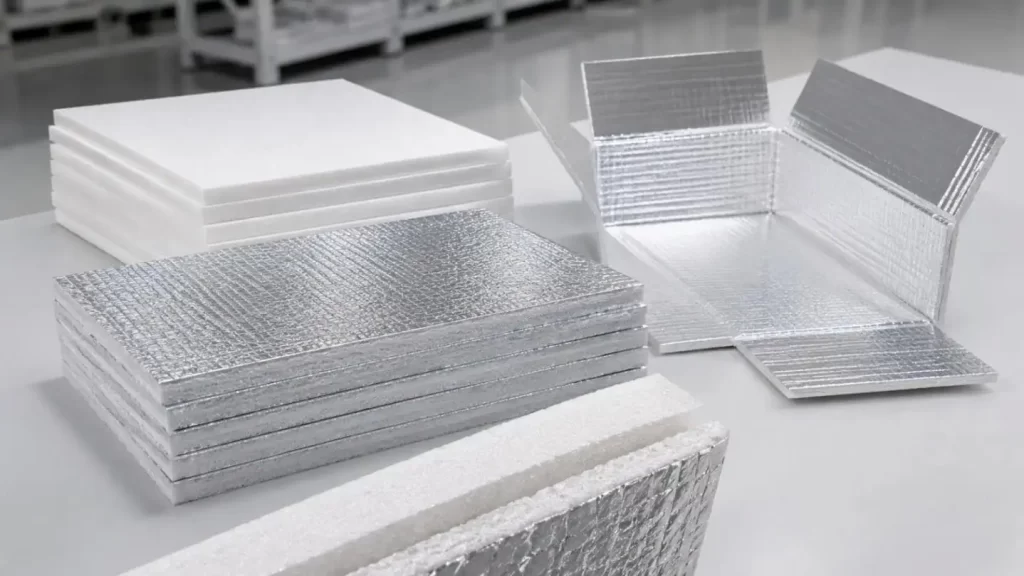
•Converts easily to rolls and panels as well as easily formable liners
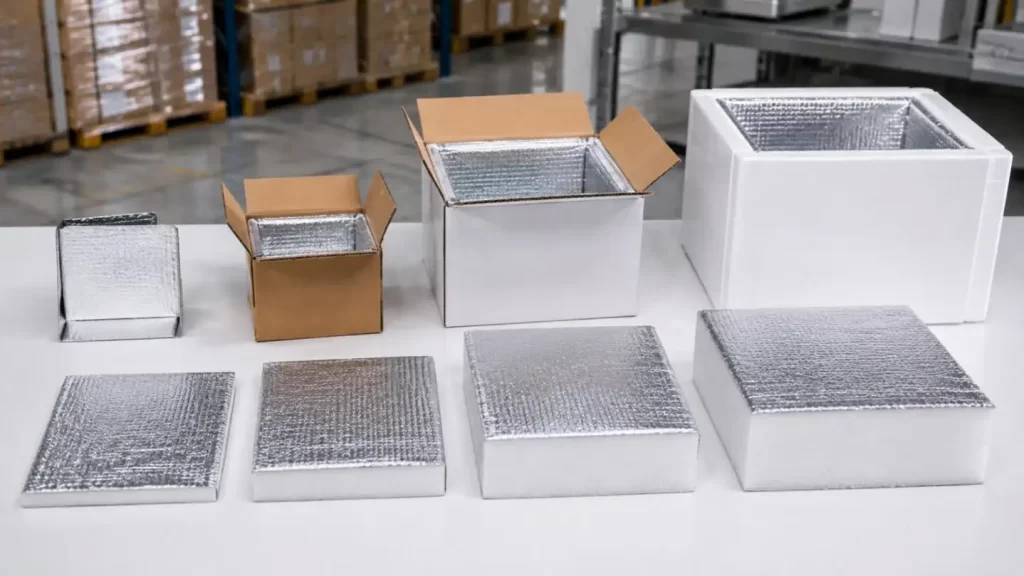
XLPE foam insulation can be die-cut, folded, laminated, or heat-sealed. It is useable in thermal bags, corrugated boxes, and reusable containers in the cold chain.
Why Is XLPE Foam Suitable for Frozen Food Shipping?
The performance of a thermal liner depends on more than nominal thickness. Cell structure, density, seam construction, surface lamination and liner coverage also affect the final result.
| XLPE Foam Property | Value in Frozen Food Packaging | Design Consideration |
| Closed-cell structure | Limits air circulation and moisture entry | Open seams can still create thermal bridges |
| Low water absorption | Reduces the effect of condensation on the insulation layer | The complete package is not automatically waterproof |
| Flexible construction | Fits different bag and carton sizes | Sharp folding may compress corners |
| Compression recovery | Helps maintain insulating thickness during transport | Excessive loading pressure can reduce performance |
| Clean surface | Separates packaged food from the outer carton | Food should remain in suitable primary packaging |
| Reflective lamination | Helps control part of the radiant heat load | Foil orientation and air gaps influence performance |
These characteristics make Cross-Linked Polyethylene Foam Insulation suitable for frozen meat, seafood, prepared food, ice cream, dairy products and selected grocery delivery applications.
How Does Cross-Linked Polyethylene Foam Insulation Control Heat Transfer?
Heat enters an insulated shipping box by three primary means.
Conduction
In insulated box systems, heat will always take its best path, or path of least resistance, through the walls and insulation. A closed-cell structure of Cross-Linked Polyethylene Foam Insulation will provide a longer and more circuitous heat-transfer path than an uninsulated box wall.
Convection
Heat will always take the best path through open spaces. The enclosed cells of XLPE foam interrupt and reduce the air movement and heat transfer that is otherwise uncontrolled and free within an open space. The air gaps will be minimized with an appropriately fitted liner.
Radiation
A reflective aluminum foil layer can reduce part of the radiant heat transfer reaching the package. However, foil does not replace foam thickness. Foam primarily adds thermal resistance, while the reflective surface addresses radiation.
Cross-Linked Polyethylene Foam Insulation Thickness Guide
Thickness selection should be based on the complete shipping profile rather than a single standard value.
| Reference Thickness | Typical Application | Key Limitation |
| 2–3 mm | Short-distance food delivery bags or supplementary liners | Limited protection during high-temperature or extended transport |
| 4–6 mm | Frozen food e-commerce boxes and local distribution | Requires complete corner, wall and lid coverage |
| 8–10 mm | Longer routes or warmer seasonal conditions | Uses more internal box space |
| Above 10 mm | Multilayer systems and custom cold-chain containers | Greater material volume and cost |
A thicker Cross-Linked Polyethylene Foam Insulation liner generally slows heat transfer more effectively. Nevertheless, increasing thickness cannot fully correct:
•Open lid gaps
•Poorly sealed joints
•Insufficient refrigerant
•Warm products loaded without pre-cooling
•Excessive empty space
•Inappropriate outer-carton construction
The final thickness should be validated against product loading temperature, target arrival temperature, transit duration, maximum ambient temperature, carton dimensions and refrigerant quantity.
Plain Foam vs. Aluminum-Foil Laminated XLPE Foam
Different surface structures serve different packaging requirements.
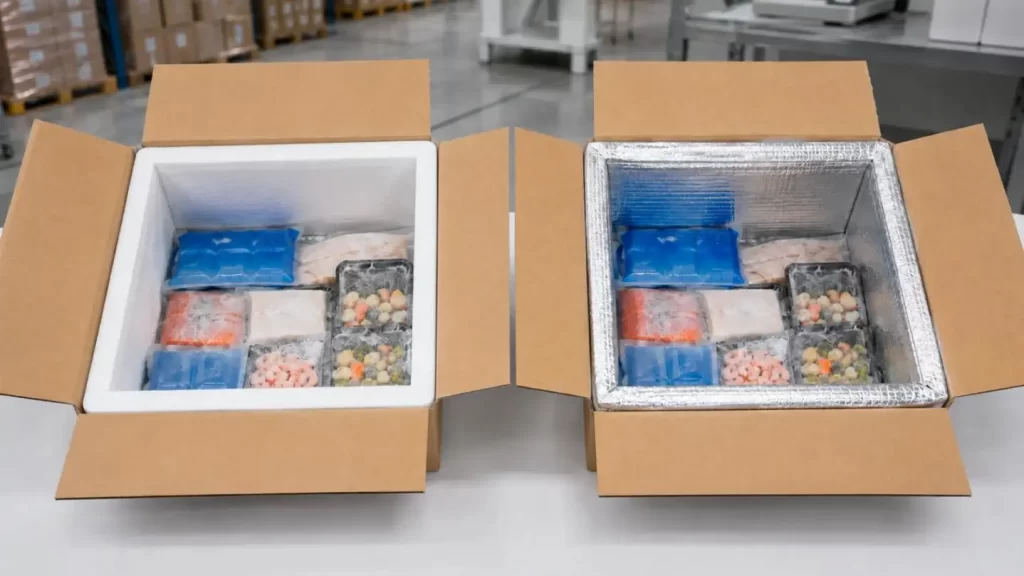
Plain XLPE Foam
Plain Cross-Linked Polyethylene Foam Insulation provides insulation, cushioning and separation from the external box wall. It can be appropriate for short delivery routes or packaging systems that already contain another reflective component.
Single-Side Foil XLPE Foam
A single reflective layer is often positioned toward the package interior. It provides a clean surface and can help reduce radiant heat when used within a properly designed structure.
Double-Side Foil XLPE Foam
Double-side lamination protects both foam surfaces and may be useful in reusable thermal bags or liners exposed to repeated handling.
Common Failures in Frozen Food Packaging
Sometimes, adequate Cross-Linked Polyethylene Foam Insulation may not perform adequately due to an inadequate overall package design.
Inadequate Liner Coverage
Thermal bridges are created by uncovered corners, edges of lids, and overlapping seams. All allow heat to enter the package.
Excessive Foam Compression
Foam insulation may be compromised if pressure is applied to foam resulting from over-packed cartons or tightly grouped canned refrigerants.
Excessive Foam
Large sections of air can increase temperature differentials throughout the package and may require additional refrigeration.
Inequitable Distribution of Refrigerants
Ice packs placed solely on the bottom of the shipper may leave the product on the sides and top of the shipper exposed to elevated temperatures.
No Route-Specific Testing
A package that works during mild weather may not perform equally well during summer transport, sorting delays or extended last-mile delivery.
How to Design an Effective XLPE Foam Liner
A structured packaging-development process should include the following steps:
- Define the temperature target. Determine whether the product must remain fully frozen or stay below a specified temperature.
- Map the shipping route. Include total transit time, transfer points, storage periods and likely ambient-temperature exposure.
- Select the foam structure. Confirm thickness, density, foil configuration and liner dimensions.
- Control seams and openings. Reduce panel gaps and provide complete lid coverage.
- Calculate refrigerant requirements. Match gel packs, ice bricks or dry ice to the product load and route.
- Standardize packing procedures. Control product position, refrigerant placement and unused space.
- Validate the complete package. Test under realistic summer and winter shipping profiles.
Build the Packaging System Around Real Shipping Conditions
Cross-Linked Polyethylene Foam Insulation can reduce heat gain, resist moisture and provide a flexible thermal liner for frozen food shipping. Reliable performance still depends on liner thickness, seam design, refrigerant quantity, loading method, outer packaging and route conditions.
GT GROUP manufactures Cross-Linked Polyethylene Foam Insulation that can be customized for thermal liners used in temperature control shipping for frozen food, beverages, e-commerce, and time-critical logistics. Available options include variability with thickness, dimensions, folding structures, and reflective laminated surfaces. To determine the best configuration of your shipping liners, contact GT GROUP to discuss your product’s size and your target shipping temperature and duration. We will assist you with a shipping liner design for transport testing.
FAQs
Q1. What Cross-Linked Polyethylene Foam Insulation products does GT GROUP offer?
GT GROUP makes Cross-Linked Polyethylene Foam Insulation for thermal bag and shipping box insulation that can be adapted to size and thickness. It has a variety of options for liner and surface lamination.
Q2. Can GT GROUP make XLPE foam liners for frozen food boxes?
GT GROUP can make liners matched to shipping‑box size, food dimensions and frozen‑food application requirements., and the location of the frozen food. They can also make liners from foldable sheets, box liners, and roll material, depending on the packaging method.
Q3. What Cross-Linked Polyethylene Foam Insulation thicknesses are available?
The thickness depends on the length of the shipment, the outside temperatures, the size of the box, the volume of the shipment, and the quantity of the refrigerant. For the more difficult cases, the starting design thicknesses can range from 2-3 mm for short shipments to 8-10 mm or more.
Q4. Does GT GROUP offer XLPE foam that has aluminum foil lamination?
GT GROUP offers Cross-Linked Polyethylene Foam Insulation that can be laminated to aluminum foil for bag and box liners for thermal insulation. It can be offered with single sided or double sided lamination based on the protection of the surface, the level of cleanliness, and the structure of the packaging.
Q5. Can GT GROUP guarantee a certain holding time for frozen items?
The foam insulation cannot guarantee a holding time for frozen items. There are many variables that play a role in a shipping and insulation system, such as the box and insulation construction, sealing quality, and the duration of shipping and the external environmental conditions. GT GROUP suggests that potential clients validate the full system of the shipping package under the external conditions, including the shipping time.
Share on Social:


