


When to Use Bubble Mailers Instead of Shipping Boxes


A bubble mailer should not be chosen over a shipping box based on the price of packaging. Product risk should be the driving factor. The weight, dimensions, crush sensitivity, surface finish, product value and distance for distribution, all play a role in selecting the appropriate shipping box.
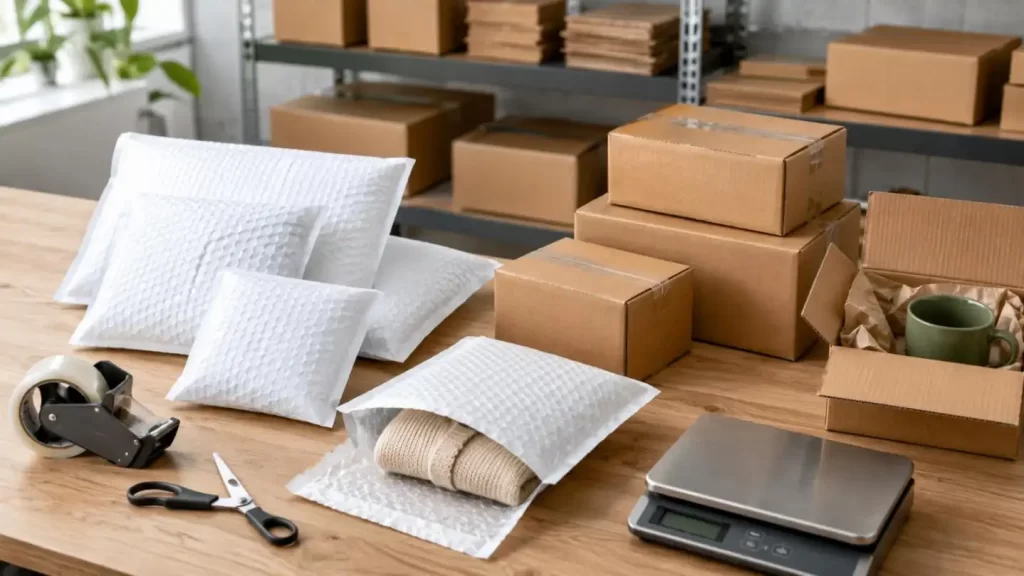
Excessive packaging means using too much material to increase the volume of packaging, increase storage, and slow down fulfillment. Not using enough packaging means that products suffer damage and customers get frustrated by having to go through the process of requesting a return, receiving a second shipment, and dealing with the inconvenience of having to ship a replacement. Using bubble mailers facilitates finding the right balance to protect a product during shipping as well as reducing the volume of material used for product packaging.
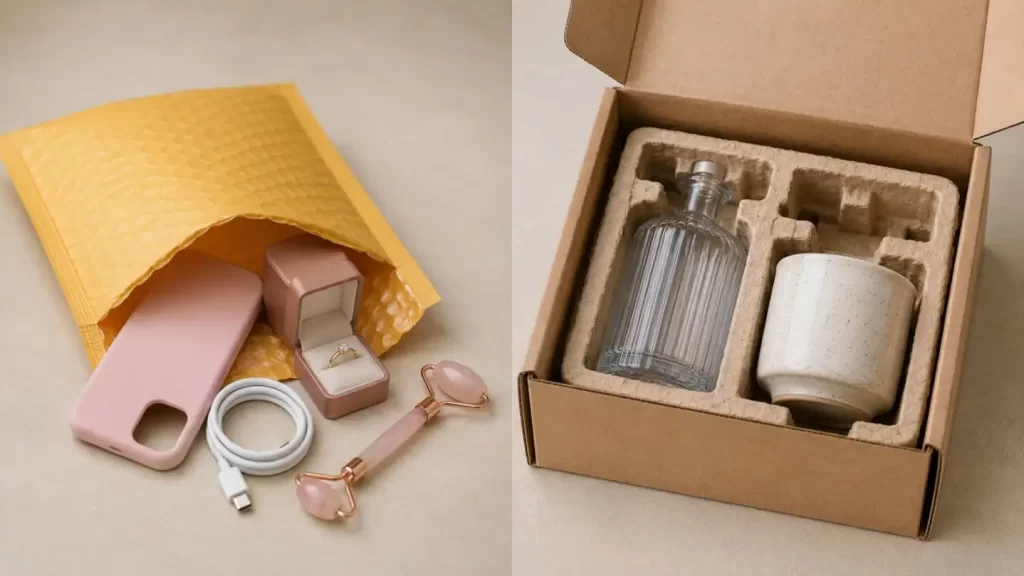
Usually, bubble mailers are appropriate for protecting products from vibration, minor impact, and scratches. For fragile products that are irregular in shape or heavier, and for products of a high value, shipping boxes are more appropriate.
What is a Bubble Mailer?
A bubble mailer is a protective mailing envelope with an air-bubble lining build up on the inner layer and with an outer layer build up on the outer side. The outer layer can be made of kraft paper, plastic films, or biodegradable material.
These mailers protect products against:
•Vibration
•Minor drops and impacts
•Contact and surface abrasion
•Dependency pressure
•Mailer contact
Most padded mailers have a pressure-sensitive self-seal strip. Some designs have additional self-seal strips, a tear-open feature a tamper-evident seal or return seal.
A bubble mailer is a more protective option than a poly mailer and less cumbersome than a box, but still provides less resistance to crushing and stacking pressure compared to a box.
When to Use Bubble Mailers for Shipping
The most reliable way to determine When to Use Bubble Mailers is to evaluate four factors: product weight, fragility, shape, and compression resistance.
Small and Lightweight Products
Bubble mailers are often appropriate for:
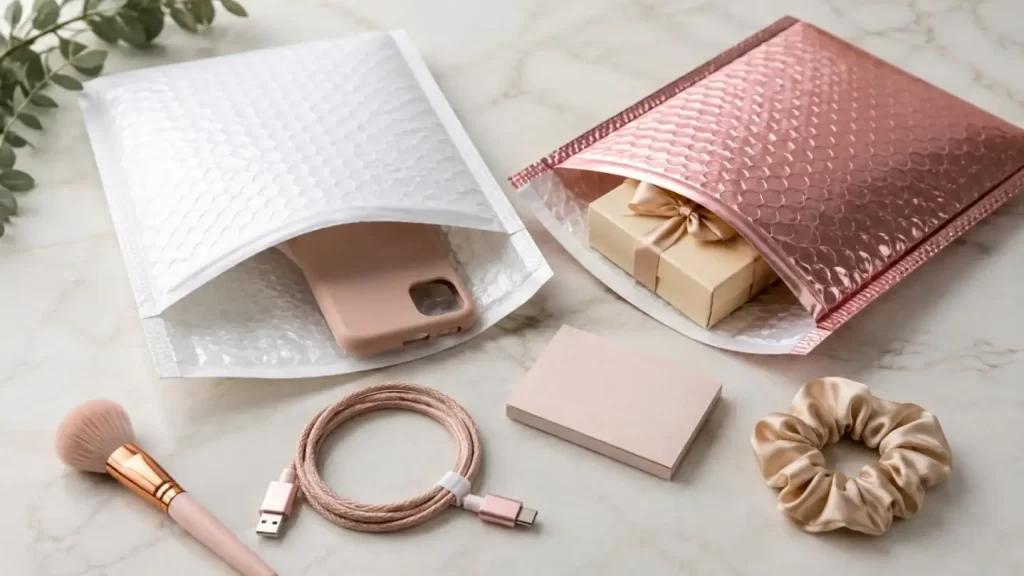
•Phone cases and charging cables
•Jewelry and small gifts
•Fashion accessories
•Beauty tools
•Stationery
•Promotional products
•Small non-fragile components
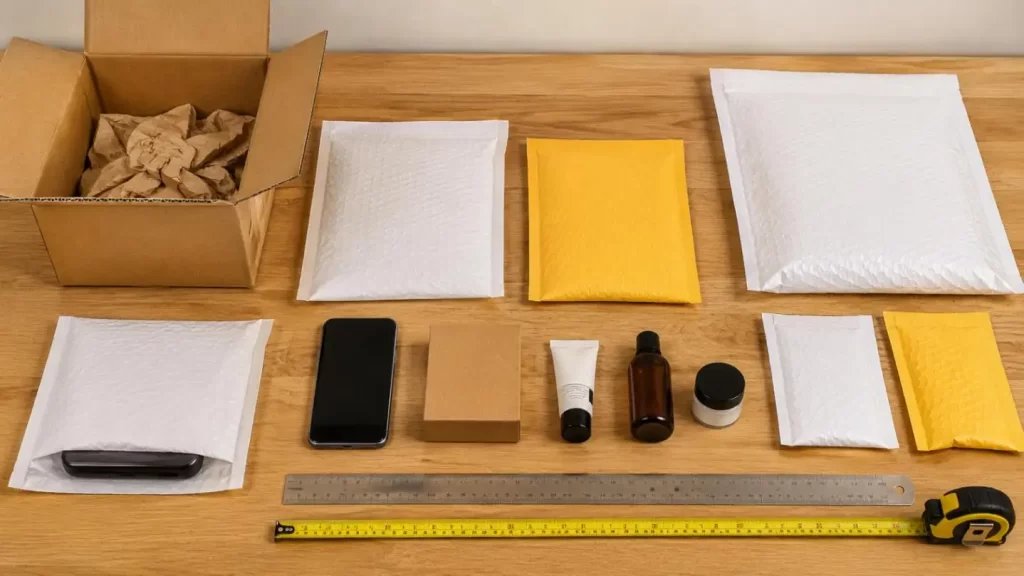
The product should fit comfortably without stretching the seams or placing pressure on the closure. At the same time, excessive empty space should be avoided because internal movement increases impact risk.
Products That Need Cushioning, Not Structural Support
A bubble lining can protect against scratches, vibration, and light handling impacts. It is useful when a basic poly bag offers too little protection but a shipping box would be unnecessarily bulky.
Bubble mailers are not designed to replace the structural support provided by corrugated board, molded inserts, dividers, or void fill. Products that may crack, bend, collapse, or lose their shape under pressure usually require a box.
Products That Can Tolerate Moderate Compression
When deciding When to Use Bubble Mailers, confirm that the product:
•Does not deform easily
•Has no sharp or fragile projections
•Does not contain an unprotected liquid
•Does not require an upright orientation
•Does not need internal separation
•Can withstand routine parcel stacking
Products with thin retail cartons may need a shipping box even when the item inside is durable, particularly when presentation quality is important.
Bubble Mailers vs. Shipping Boxes
| Evaluation Factor | Bubble Mailers | Shipping Boxes |
| Packaging weight | Low | Moderate to high |
| Parcel volume | Closely follows product size | Often requires additional space |
| Cushioning | Light to moderate | Adjustable with inserts and void fill |
| Compression resistance | Limited | Stronger |
| Product restraint | Limited | Can use dividers or custom inserts |
| Packing speed | Fast self-seal process | Folding, filling, and taping required |
| Storage requirement | Low | Higher |
| Best suited for | Small, light, regular products | Heavy, fragile, irregular, or valuable products |
| Return convenience | Can include a second seal | Usually requires new tape |
| Environmental profile | Depends on material and disposal route | Depends on board source, weight, and recycling |
Bubble mailers can reduce packaging weight, but they may not reduce freight costs. Pricing for carriers depends on the level of service, parcel size, destination, minimum charges, and dimensional weight.
Products Shipped in Bubble Mailers
Textile Accessories
Small textile items such as belts, hair accessories, and socks often need bubble mailers to protect them from dirt and moisture and light abrasions.
Electronics Accessories
Bubble mailers are suitable for shipping small electronic accessories and cases. They may be used for shipping protective covers, adapters, and cables. Cables can also contain electronic components which may require dissipative packaging. Bubble mailers may not safeguard sensitive components from electrostatic discharge.
Personal Care Items
Bubble mailers can be used to ship applicators, sponges, and brushes. When loose glass components or liquids are shipped, care should be taken.
Printed Items
Photographs, cards, and thin books can be shipped using bubble mailers. If bending is a concern then use a reinforced mailing envelope.
When Not to Use Bubble Mailers
Knowing When to Use Bubble Mailers also means knowing when to avoid bubble mailers.
Bubble mailers should NOT be used for:
Dense or Heavy Items
Bubble mailers can be punctured or their seams can tear when they receive impact from drops.
Fragile Items
Glass, ceramics, and fragile electronics should always be packaged in a rigid box and protected with cushioning. Cosmetic containers should always be packed in a rigid box.
Crush or Bend Sensitive Products
Do NOT use a bubble mailer for:
•Packaging that is collectible
•Thin retail cartons
•Hardcover books
•Plastic that is thin and delicate
•Products that MUST be packaged to maintain their presentation
•Shipments that contain multiple items
Packaging several items together will allow them to collide, scratch, or concentrate pressure against each other. Boxes put distance between each item and allow them to be immobilized.
High-Value Products
High-value goods may require stronger tamper evidence, concealed external packaging, tracking labels, internal restraints, and greater resistance to unauthorized access.
Choosing the Right Bubble Mailer
Once a product is considered suitable, the mailer specification must still be matched to the application.
Select the Correct Size
Before choosing a mailer, measure the length, width, and thickness of the product. A mailer should be chosen that provides a small amount of extra space for the insertion/closure of the flaps while holding the product lightly to prevent movement.
A mailer that is too small may:
•Compress the product
•Stress the side seams
•Reduce the adhesive contact area
•Cause closure failure
A mailer that is too large may allow repeated movement and impact.
Evaluate Cushioning and Construction
Review:
•Bubble diameter and height
•Lining uniformity
•Seam strength
•Puncture resistance
•Adhesive performance
•Moisture resistance
•Tear and return features
The correct bubble thickness depends on product weight, geometry, sensitivity, and expected handling conditions.
Review the Outer Material
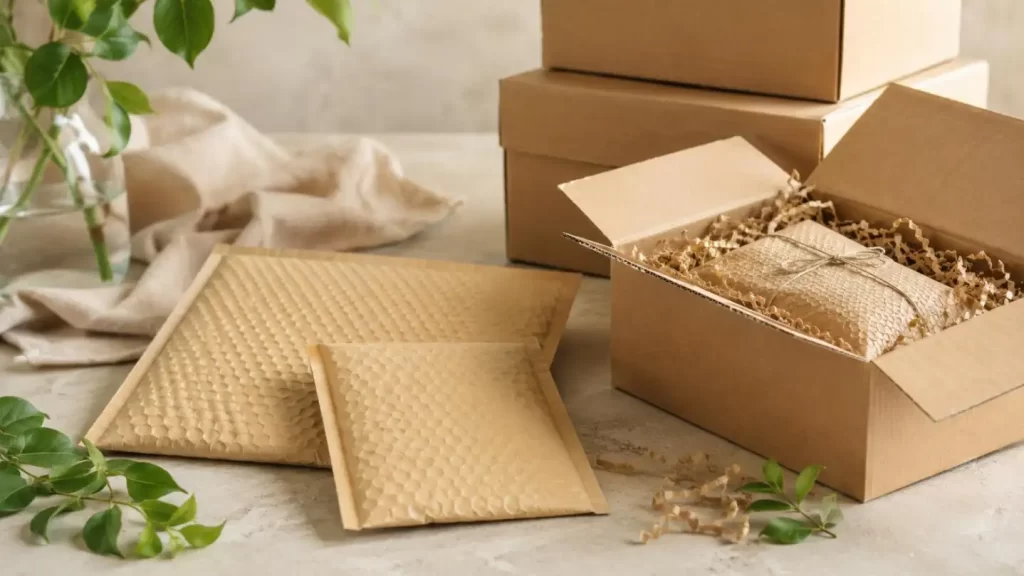
Between plastic and kraft exteriors, plastic exteriors usually offer better moisture resistance. Kraft exteriors are paper based and have good printability. While biodegradable bubble mailers might be better for some environmentally focused packaging, their material claims should be reviewed alongside appropriate testing and the conditions of the local disposal.
Environmental Considerations
Lightweight shipping packages reduce bulk during shipping, but we must consider the overall environmental consequences of shipping in this scenario.
Lightweight packaging can still be highly inefficient, offering little to no protection and resulting in damage, return, and repackaging costs and promoting additional shipping. Just because a packaging material is easily broken down does not mean it is biodegradable. Companies should evaluate the packaging material, the method of disposal, and the claims and certifications along with the local waste management.
Bubble Mailer or Shipping Box? Final Decision
The best packing solution depends on product weight, fragility, size, and even the surrounding conditions. GT GROUP offers Biodegradable Bubble Mailers and Shipping Boxes to all customers.
Based on customer needs, we provide solutions for customizing packaging that can take into account choice of material, dimensions, cushioning, and even printing and box construction. To explore our sustainable packaging solutions further, reach out to us!
FAQs
Q1. When are bubble mailers appropriate over shipping boxes?
Shipping boxes can store heavier, fragile, or more crushable products, while bubble mailers can store smaller, lighter, and more regularly shaped products needing cushioning.
Q2. Does GT GROUP sell bubble mailers and shipping boxes?
Yes. GT GROUP sells custom bubble mailers and shipping boxes.
Q3. What types of bubble mailers can GT GROUP sell?
GT GROUP sells bubble mailers constructed of varying materials, have different sizes and colors, and even different cushioning and biodegradable structures.
Q4. Can GT GROUP adjust the size of bubble mailers?
Yes. The size can be adjusted in accordance with the restrained product's size, weight, and thickness, as well as the amount of cushioning space. This helps prevent movement and wasteful packing space.
Q5. Can GT GROUP customize shipping boxes designed for fragile products?
Yes. Different layers and cushioning can supplement shipping boxes and can also be made with varying board materials, closures, dividers, and inserts based on product and transport risk.
Share on Social:


