


Poly Mailer vs Bubble Mailer: Which Should Ecommerce Brands Use?


Choosing between a poly mailer and a bubble mailer comes down to one central question: does the product need cushioning, or only a lightweight outer layer?
For soft, non-fragile products such as T-shirts, leggings and fabric accessories, a poly mailer is usually the more efficient option. It is lightweight, compact and easy to pack. For small products that can be scratched, dented or damaged by minor impacts, a bubble mailer provides built-in cushioning without requiring a full shipping box.
Neither option is right for every order. Products that can break, crush, leak or puncture their packaging may need a corrugated box, rigid mailer or a more specialized protective solution.
This guide compares poly mailers and bubble mailers by protection, shipping efficiency, storage, branding and sustainability so ecommerce brands can choose packaging based on product risk rather than guesswork.
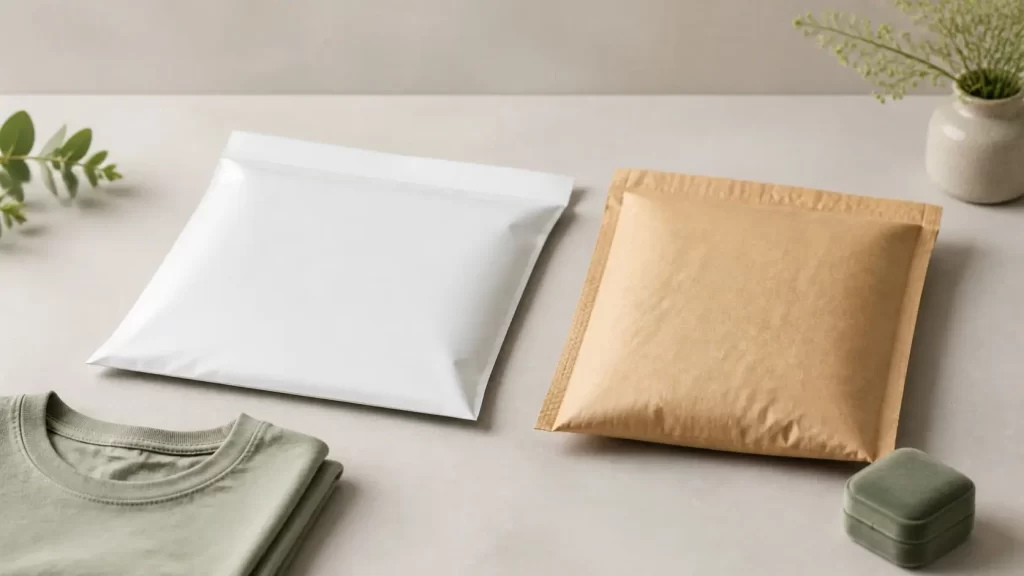
What Is a Poly Mailer?
A poly mailer is a flexible shipping envelope typically made from polyethylene film. Most designs include a peel-and-seal adhesive closure and an opaque or co-extruded film that helps protect the contents from moisture, dust and handling during delivery.
Poly mailers do not contain built-in padding. Their main job is to provide a lightweight outer layer around products that already resist normal pressure and movement.
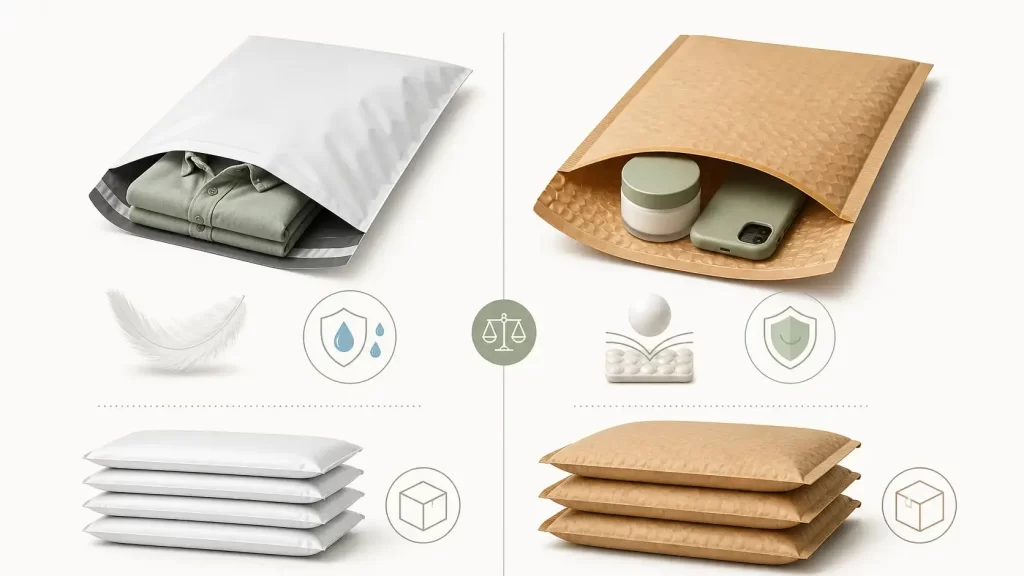
Common products shipped in poly mailers include:
- T-shirts, hoodies and activewear
- Socks, scarves and other fabric accessories
- Towels and lightweight linens
- Soft toys without rigid or delicate components
- Non-fragile replacement parts
- Products already protected by suitable retail packaging
Poly mailers are especially useful for high-volume fulfillment because they arrive flat, take up little storage space and can be sealed quickly at the packing station.
What Is a Bubble Mailer?
A bubble mailer is a padded shipping envelope with an outer film or paper layer and an inner layer of air-filled cushioning. The padding helps absorb minor impacts and reduces movement, rubbing and surface damage during sorting and delivery.
Bubble mailers offer more protection than unpadded poly mailers, but they are not a replacement for a box when an item needs structural or compression protection.
Typical bubble mailer applications include:
- Jewelry and fashion accessories
- Phone cases and small electronic accessories
- Cosmetics in non-breakable containers
- Collectibles and promotional products
- Small books and media products
- Components that may scratch or rub against the outer packaging
- Lightweight items with small rigid edges
Bubble mailers are a practical middle option when a plain bag offers too little protection but a corrugated box would add unnecessary material and volume.
Poly Mailer vs Bubble Mailer: Quick Comparison
| Factor | Poly mailer | Bubble mailer |
|---|---|---|
| Best for | Soft, flexible and non-fragile goods | Small items needing light cushioning |
| Internal padding | None | Built-in bubble layer |
| Impact protection | Low | Moderate |
| Compression protection | None | Limited |
| Packaging weight | Very low | Low, but higher than a poly mailer |
| Storage requirement | Minimal; stores flat | Higher because of the padded layer |
| Packing speed | Very fast | Fast |
| Typical unit cost | Usually lower | Usually higher |
| Moisture resistance | Depends on film and closure | Depends on exterior material and closure |
| Printing options | Well suited to full-surface branding | Available, but varies by exterior material |
| Best brand use case | Cost-efficient, streamlined fulfillment | More protective or premium presentation |
The right choice should be based on the product’s shape, fragility and value—not simply on which mailer has the lowest unit price.
When Should Ecommerce Brands Use Poly Mailers?
1. The product is soft and difficult to damage
Clothing and textile products usually do not require impact cushioning. A correctly sized poly mailer can protect these items from dust, moisture and handling while keeping the parcel light.
If a product can safely tolerate normal stacking and movement, adding bubble padding may increase cost and storage requirements without meaningfully reducing risk.
2. Shipping efficiency is the main priority
Poly mailers use little material and add minimal packaging weight. Their flexible format can also avoid the unused space often found in oversized boxes. Actual carrier charges depend on parcel dimensions, weight, destination and service level, so brands should test packed orders rather than rely on a general assumption.
3. The warehouse handles a high number of orders
Flat mailers are easy to store near packing stations. Employees can insert the product, remove the release liner, seal the flap and apply a shipping label with few steps.
Return-ready versions with two adhesive strips can also simplify reverse logistics. The customer opens the package using a tear strip and uses the second adhesive strip if the product needs to be returned.
4. The product already has primary protection
Some items arrive at the packing station inside a durable retail box, fabric pouch or protective inner wrap. If that primary packaging already provides sufficient protection, a poly mailer may serve as the weather-resistant shipping layer.
The inner package should still be tested for crushing and corner damage. A poly mailer does not add rigidity.
When Should Ecommerce Brands Use Bubble Mailers?
1. The product needs protection from minor impacts
Bubble mailers cushion products against the bumps and vibrations of normal parcel handling. They are appropriate for items that are not highly fragile but could be scratched, scuffed or dented in an unpadded bag.
2. Loose movement could damage the product
Choosing a properly sized bubble mailer reduces empty space around the item. This can help limit movement without adding separate bubble wrap or loose fill.
The fit should be snug but not tight. Overfilling stretches the seams and closure, while an oversized mailer allows the item to move.
3. A box would be excessive
Small accessories, media products and non-glass cosmetics may need more protection than a plain poly bag but not the stacking strength of corrugated packaging. A bubble mailer can provide a useful balance between protection and shipping efficiency.
4. The unboxing experience should feel more substantial
The padded construction can make a shipment feel more protective and deliberate. Custom printing, brand colors and a clean adhesive closure can turn the mailer into a recognizable customer touchpoint.
Brand presentation should not replace packaging performance, however. The first responsibility of any shipping package is to deliver the product in acceptable condition.
When Is Neither Mailer the Right Choice?
Use a corrugated box, rigid mailer or engineered protective package when the product:
- Can crack, shatter or break
- Can be crushed or permanently bent
- Contains glass or a fragile liquid container
- Has sharp corners or exposed metal edges
- Is heavy enough to stress the mailer seams
- Requires orientation, temperature control or tamper-evident packaging
- Needs custom inserts to prevent movement
- Must comply with product-specific carrier or regulatory requirements
A bubble mailer offers cushioning, but it provides limited resistance to heavy stacking pressure. If a product needs both impact absorption and structural strength, use a box with suitable cushioning or inserts.
Seven Factors to Consider Before Choosing
1. Fragility
Start with the likely failure mode. Can the product tear, dent, scratch, bend or break? A soft sweatshirt and a compact mirror may have similar dimensions but require completely different protection.
2. Shape and edges
Rigid corners and protruding parts can puncture a mailer from the inside. Add edge protection, select a heavier construction or move to a box when the product creates concentrated pressure points.
3. Product value and replacement cost
The least expensive package is not always the lowest-cost option. Consider the total cost of damage: replacement stock, reshipping, customer service time, refunds and lost customer trust.
For higher-value items, a small increase in packaging cost may be justified if testing shows a meaningful reduction in damage.
4. Packed size and shipping method
Measure the final sealed parcel, not just the product. Review the pricing and packaging rules for every carrier and destination you use. A package that performs well with one service may fall into a different size or handling category with another.
5. Packing-line productivity
Compare how long each package takes to assemble, fill, seal and label. A mailer that removes the need for separate wrapping may improve throughput even if its unit cost is higher.
6. Returns
For apparel and other high-return categories, a second adhesive strip and an easy-open tear strip can improve the customer experience. Test whether the returned package remains secure after opening.
7. Customer expectations
Packaging should match the product and brand promise. Minimal packaging may suit a value-focused apparel brand, while a premium accessory brand may prefer a padded, custom-printed presentation.
What About Sustainability?
There is no universal answer to whether a poly mailer or bubble mailer is more sustainable. The outcome depends on material use, recycled content, product protection, transport efficiency, reuse and the recovery systems available where customers live.
Consider the following questions:
- Does the package contain verified post-consumer recycled material?
- Is it made from one material or several bonded materials?
- Can customers realistically reuse or recycle it in the destination market?
- Are recycling instructions clear and accurate?
- Is the mailer sized correctly, without unnecessary material?
- Does it protect the product well enough to prevent waste from damage and reshipping?
An all-poly mailer may be accepted by some flexible-plastic collection programs, while a paper-and-plastic bubble mailer can be more difficult to separate. Collection rules differ by country and municipality, so avoid broad claims such as “100% recyclable everywhere.”
Compostable and biodegradable claims should also be supported by relevant testing and certification. Brands should state whether a material is intended for home or industrial composting and provide disposal instructions that match the actual product.
How to Test Mailers Before Placing a Large Order
Packaging decisions should be validated with the real product and distribution process. Before scaling, run a small trial that includes:
- Packing the lightest, heaviest and most awkward product variations.
- Checking whether corners, closures or seams are under excessive tension.
- Testing abrasion, puncture resistance and seal integrity.
- Shipping samples through the carriers and routes used by the business.
- Inspecting the package and product after delivery.
- Recording packing time, package weight and final dimensions.
- Comparing damage and return results against the current package.
For higher-risk products, consider formal transit testing based on the expected distribution environment. A sample that looks secure on a packing table may behave differently after repeated drops, vibration, compression and changes in temperature.
A Practical Decision Matrix
| Product | Recommended starting point | Reason |
|---|---|---|
| T-shirts and soft apparel | Poly mailer | Flexible and generally does not need cushioning |
| Hoodies and fabric products | Poly mailer | Efficient for soft, compressible goods |
| Jewelry in a protective case | Bubble mailer | Helps cushion the retail case |
| Phone cases and small accessories | Bubble mailer | Reduces scuffing and minor impact risk |
| Books | Bubble or rigid mailer | Choice depends on corner and bending protection needed |
| Non-glass cosmetics | Bubble mailer | Adds light cushioning; check leakage risk separately |
| Glass bottles | Corrugated box with cushioning | Requires structural and impact protection |
| Ceramics | Corrugated box with engineered protection | A bubble mailer alone is insufficient |
| Electronics | Tested bubble mailer or box | Depends on product sensitivity and retail packaging |
| Temperature-sensitive goods | Insulated packaging system | Requires thermal performance, not only impact protection |
Poly Mailer vs Bubble Mailer: The Final Answer
Choose a poly mailer when the product is soft, non-fragile and unlikely to be damaged by pressure or movement. It is normally the best starting point for apparel, textiles and other flexible goods where low packaging weight, compact storage and fast fulfillment matter most.
Choose a bubble mailer when a small product needs light cushioning against bumps, rubbing or surface damage. It is well suited to accessories, selected cosmetics, media products and other items that need more protection than a plain shipping bag but do not require a rigid box.
Choose a box or rigid protective format when the item can break, crush, leak, bend or puncture the package. The correct decision is the one that delivers the product safely with the least unnecessary material and operational cost.
MailersFactory supplies poly mailers, bubble mailers and custom packaging options for different ecommerce applications. If you are comparing materials, sizes or printing options, review our custom packaging services or contact our team to discuss your product, order quantity and shipping requirements.
Frequently Asked Questions
Are bubble mailers better than poly mailers?
Bubble mailers are better when a product needs light cushioning. Poly mailers are usually more efficient for soft, non-fragile products. Neither is universally better; the correct choice depends on the product’s damage risk.
Can clothing be shipped in a poly mailer?
Yes. Poly mailers are commonly used for T-shirts, hoodies, leggings and other soft textile products. Use an appropriate size, seal the package correctly and add inner protection when the product could be affected by moisture, dye transfer or abrasion.
Are bubble mailers safe for fragile items?
They are suitable for items requiring light impact and surface protection, but not for every fragile product. Glass, ceramics, crushable goods and high-value electronics usually need a rigid box and tested cushioning.
Which mailer costs less?
Poly mailers generally have a lower unit cost and use less storage space because they contain no padded layer. The true cost should also include packing labor, shipping charges, damage, returns and replacement shipments.
Do bubble mailers cost more to ship?
They normally weigh more and take up more space than unpadded poly mailers, but the actual shipping cost depends on the carrier, service, parcel measurements, weight and destination. Compare fully packed samples using your carrier rates.
Can poly mailers and bubble mailers be custom printed?
Yes. Both formats can be customized with logos, colors, sizes and printing, although available print methods and coverage depend on the exterior material and order quantity.
Are poly mailers waterproof?
Many polyethylene mailers are highly moisture resistant, but complete protection depends on the film, seams, closure and any punctures. Use “water resistant” unless the finished package has been tested to support a stronger claim.
What size mailer should an ecommerce brand choose?
Choose a mailer that fits the packed product without excessive empty space or strain on the seams. Measure the product’s length, width and thickness, then test the selected size with the actual item before ordering in bulk.
Share on Social:


