


Paper Padded Mailers vs. Bubble Protective Envelopes for Shipping: A Practical Comparison


Small e-commerce products can't always rely on standard poly mailers for protection. Packaging a delivery too lightly can result in a scratched product, crushed corners, or product becoming moisture damaged. These can all result in unwanted product return shipments. Products packaged too heavily can also lead to poor shipping economics.
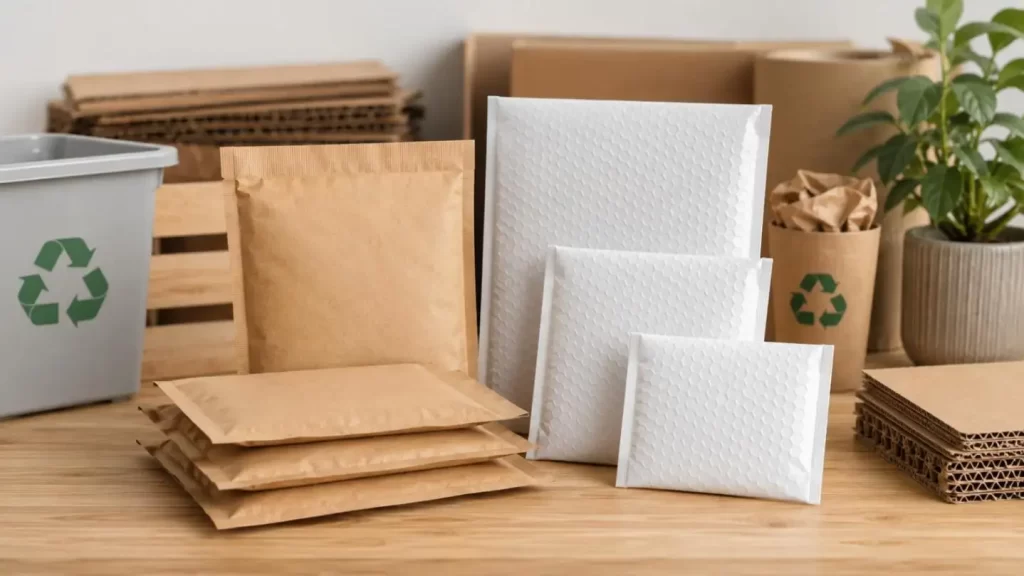
Other types of product packaging (such as shipping boxes) may also not always be required, for example, when shipping books, apparel, accessories, cosmetics, electronics, and small components. In these situations, Protective Envelopes for shipping can provide the necessary level of protection. The most common types of Protective Envelopes for shipping are paper padded mailers, and bubble mailers.
Paper padded mailers tend to be a better fit for products that require a paper-based appearance and need moderate cushioning and/or disposability in the paper stream. Moisture resistant shipping protective envelopes tend to provide better cushioning, and are better suited for multiple shipment handling.
The selection should be based on product fragility, shipping distance, expected moisture, potential puncture, and the recycling system of the shipping destination.
What Are Paper Padded Mailers?
Paper padded mailers combine a paper exterior with an internal cushioning structure. The outer layer is commonly kraft paper, while the protective layer may use:
•Shredded or macerated paper fibers
•Embossed paper padding
•Honeycomb paper
•Multi-layer kraft structures
•Paper-based cushioning panels
Most designs include a pressure-sensitive adhesive strip, tear-open feature, or tamper-evident closure. All-paper versions may be placed in paper recycling streams where local facilities accept the complete structure.
Key Advantages
•Natural kraft appearance
•Ideal for labeling and printing
•Resistant to light abrasion and low impact
•Will appeal to companies who prefer to use paper-based packaging
•Because they are made entirely of paper, users can easily identify the material
Practical Limitations
Humidity will impact the weight and size of paper-based cushioned mailers as the cushion will be thicker and of a higher paper grade. Disposal will be more complicated for coated mailers, mailers with plastic liners, or reinforced laminate mailers.
What Are Bubble Protective Envelopes for Shipping?
Bubble mailers are constructed with a polyethylene film or a co-extruded film, kraft paper, metallic film or other laminated materials. The insides of the mailers will contain an air cushion. Other features may include
•Air cushioning
•Water resistant surfaces
•Permanent or resealable adhesives for self-sealing
•Chemically joined sealing strips that cannot be reopened
•Films that are tear resistant
•Monomaterial polyethylene
Bubble Protective Envelopes for Shipping are used for long-distance transport via courier services and products that are transported via multiple sorting centers.
Their main limitation is end-of-life handling. Paper-plastic laminates are not easily separable, while mono-PE envelopes are dependent on local polyethylene collection programs.
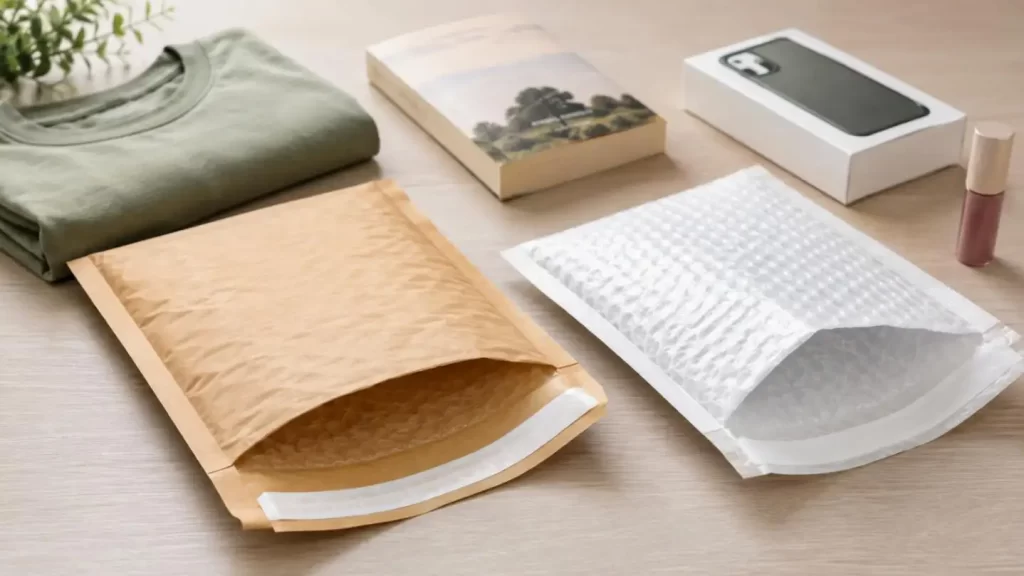
Paper Padded Mailers vs. Bubble Protective Envelopes for Shipping
| Performance Factor | Paper Padded Mailers | Bubble Protective Envelopes |
| Impact protection | Moderate; structure-dependent | Good for light and repeated impact |
| Moisture resistance | Limited without coating | Generally higher |
| Empty packaging weight | Often higher | Usually lower |
| Scratch protection | Good with soft paper lining | Good with intact bubble lining |
| Puncture resistance | Depends on paper strength | Suitable for regular items; sharp parts need reinforcement |
| Recyclability | All-paper designs may be easier to sort | Mono-PE may be recyclable; laminates are more complex |
| Printing | Natural appearance and strong label adhesion | Supports high-coverage graphics |
| Typical routes | Dry, short- to medium-distance shipping | Long-distance or multi-stage distribution |
Neither material is universally better. The most appropriate Protective Envelopes for Shipping are those matched to the actual hazards of the distribution process.
Which Provides Better Product Protection?
Protection should be evaluated against specific shipping risks rather than material types.
Paper Padded Mailers Provide Protection When:
•The products are flat or regular shaped and can be laid on a surface.
•Moderate cushioning is required.
•Moisture exposure is low.
•A presentation of paper is preferred.
•The Products do not contain sharp edges.
Bubble Mailers provide good protection when:
•There is a potential for a lot of handling of packages.
•The products are sensitive to scratches.
•Moisture resistance is needed.
•Packaging weight is low.
•Products have a slightly irregular shape.
For glass items, sensitive electronics and precision instruments or sharp metal parts, neither envelope protects them alone. These products can require edge guards, foam inserts, rigid trays, antistatic and corrugated outer protective packaging.
Which Provides More Sustainability, Paper or Plastic?
The comparison of paper to plastic cannot determine sustainability. A better approach considers the whole packaging and logistics system.
The following factors are key components of the system:
•Net weight per shipment
•Weight of empty envelopes
•Recycled content
•Bubble envelopes are less insulating but have a low weight.
The sustainability of protective envelopes depends on the balance among the material, transport and recycling impacts and protection from product damage. A shipped product that is packaged and then shipped again also increases the transport impact.
Effects of Packaging Weight and Size on Shipping Cost
Shipping costs may depend on actual weight, dimensional weight, or greater of the two. Volumetric packaging leads to higher costs and unnecessary expense on shipping, even if the product is lightweight.
Bubble mailers provide good cushioning as they add little mass to the package. Paper mailers may help with the plastic problem, but these become less eco-friendly if the paper used is of a higher grade and if there is a lot of thick padding.
Consumers should take into account these factors when looking at Protective Envelopes for Shipping:
•Weight of empty envelope
•Packed dimensions
•Weight of the final shipment
•Cushioning thickness
•Damage rate during testing
•Units stored per carton or pallet
An empty envelope with the lowest weight may not always have the lowest overall costs of shipping.
Recommended Applications
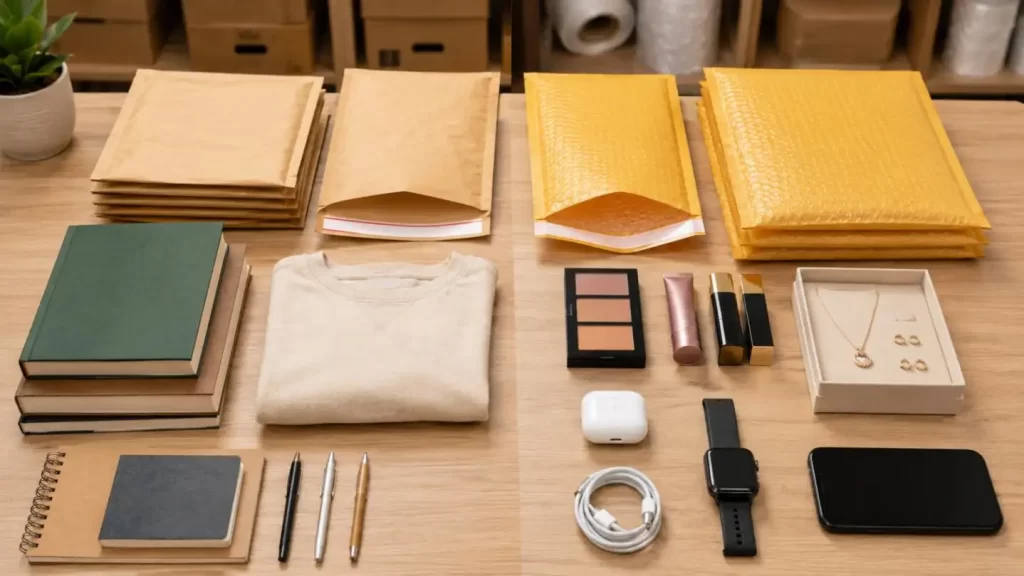
| Product Type | Preferred Starting Option | Main Reason |
| Books and printed materials | Paper padded mailer | Paper presentation and moderate protection |
| Clothing and textile accessories | Paper or bubble mailer | Depends on moisture exposure |
| Phone accessories | Bubble envelope | Lightweight impact protection |
| Cosmetics and skincare | Bubble envelope | Moisture and surface protection |
| Stationery and craft items | Paper padded mailer | Regular shape and moderate fragility |
| Jewelry and small accessories | Bubble envelope | Scratch and impact protection |
| Small hardware components | Reinforced bubble envelope | Better resistance to handling risks |
Common Selection Errors
Examples of purchasing errors include:
•Limiting yourself to considering only packaging materials when making selections.
•Assuming all paper mailers are fully recyclable.
•Failing to consider the presence of sharp corners and puncture risks.
•Using envelopes that are too large.
•Adding extra cushioning without conducting impact test (if cushioning is supplied).
•Overlooking adhesive-seal temperature testing.
•Using the same envelope specification for all products.
•Overlooking coatings and laminates when evaluating how a product is disposed of
Choosing Proper Protective Envelopes for Shipping
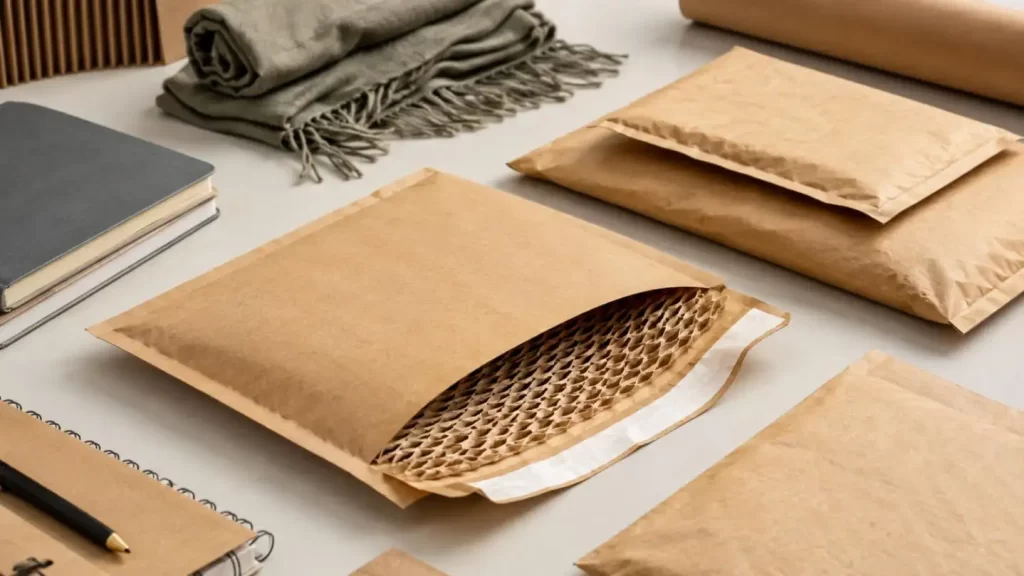
Paper padded mailers are appropriate for products that need a paper presentation, light cushioning, and a paper stream recycling path. Bubble mailers are often a better choice for products that need high-impact protection, are lightweight, and are waterproof.
The most appropriate choice will depend on the product, destination, the dimensions of the package, the materials, the disposition of the package, and the required performance.
Develop Protective Mailing Solutions with GT GROUP
Cushioning, weight, moisture protection, integration of multiple materials, and printed packaging are all factors to consider when selecting the best protective mailing packaging.
Gaote Group Co., Ltd. (GT GROUP) is based out of Hong Kong and Dongguan Guangdong. It manufactures mailing envelopes, insulated cooler bags, and various thermal insulation products for its customers around the world. A production unit consisting of film-blowing, laminating, slitting, printing systems, bag-converting and a quality-testing system is all integrated in one location.
Companies can work with GT GROUP to evaluate paper-padded mailers and bubble mailers along with the different sizes and performance tests required based on the shipping method.
Sustainable Solutions for a Greener Future
High-Capacity Manufacturing with Global Standards
FAQs
Q1. What Protective Envelopes for Shipping does GT GROUP make?
GT GROUP specializes in manufacturing a range of protective envelopes used for shipping and e-commerce purposes. Notable options include padded envelopes, bubble lined envelopes, film envelopes, and custom protective envelopes designed around the product and logistics of distribution.
Q2. How does GT GROUP make the decision between paper padded mailers and bubble mailers?
Based on the assessment of the characteristics of a given product, GT GROUP can recommend if a paper padded or bubble cushioned envelope is more appropriate. These characteristics include, but are not limited to, the dimensions of the product, weight of the product, fragility (if it is breakable), moisture sensitivity, the route the package will take, the weight of the package, and how the package will be disposed of.
Q3. Is it possible for GT GROUP to manufacture Protective Envelopes for Shipping of custom size?
The size of the envelopes can be designed to match the size of the product and the space required for a protective cushion. Custom sizing minimizes the volume of the envelopes, consumption of material, and volume of protective cushion required.
Q4. Does GT GROUP provide custom protective mailing envelopes with print services?
GT GROUP uses printing and bag conversion systems to create envelopes for mailing purposes. It is possible to discuss the placement and creation of logos, as well as printing the artwork and select materials.
Q5. What processes does GT GROUP control to ensure quality of Protective Envelopes for Shipping?
GT GROUP has systems to control the quality of printed protective envelopes. These include film blowing, laminating, slitting, printing, bag converting, and quality testing systems.
Share on Social:


