


Custom Logo Compostable Poly Mailers for Sustainable Fashion Brands


Sustainable fashion brands are looking at every aspect of their packaging. This includes the mailers that contain the clothes that are sent directly to customers. The traditional poly mailer is lightweight, compact, and economical to ship. However, a larger packaging concern is packaging waste, combined with environmental impact and traceability of materials. In addition to traditional mailer performance, packaging designers must account for the impact after use.

Poly Mailers designed for a specific brand are made of materials that decompose after a period of time. Before using these poly mailers, designers must consider much more than the base film. This includes printing inks, adhesive closures, heat-sealed edges, the scope of certifications, storage stability, and local composting.
Why Fashion Brands Are Rethinking Shipping Mailers
Most clothing and textile products do not require rigid packaging. A flexible mailer can protect clothing from dust and moisture while reducing package weight and volume.
Packaging must meet many complex demands:
•Protective packaging for sorting and delivery
•Low weight
•Packaging that represents a brand
•Clear environmental impact assessment
•Packaging of various dimensions depending on the garment size
•Responsive design for the existing waste systems
•Packaging at an affordable price with the option for customization
Custom Logo Compostable Poly Mailers have the potential to meet these demands. However, they should not be considered a fully sustainable solution. The actual value of the mailer is reliant on the material contents and the disposal situation, the ratio of the mailer to package, and whether customers have access to composting.
What Are Custom Logo Compostable Poly Mailers?
As the name suggests, these mailers are flexible shipping envelopes with printed mailers constructed of compostable materials.
| Term | Practical Meaning |
| Custom Logo | Printed branding, graphics, website details, or handling details |
| Compostable | Designed to break down under specific conditions of composting |
| Poly Mailer | Flexible mailer for shipping light, non-breakable items |
| Certified Compostable | Tested for compliance against a compostability standard |
| Biodegradable | Capable of breaking down biologically. Does not necessarily mean it can compost |
A biodegradable mailer does not mean it is suitable for home or commercial composting. Likewise, a bio-based material may still contain traditional polymer components.
To ensure the whole structure of a Custom Logo Compostable Poly Mailer is evaluated, buyers should ask for an assessment of the following:
•Base film
•Printing inks
•Adhesive closures
•Heat-sealed seams
•Color additives
•Printed areas
•Secondary labels or closures

Why Custom Branding Matters in Sustainable Fashion Packaging
The shipping mailer is typically the first contact the customer has with the brand. Printing custom logos can change the mailer from a basic transport pouch to a communication tool.
Custom Logo Compostable Poly Mailers can contain:
•Brand logos and graphic elements
•Websites and social media links
•Return-handling instructions
•Material explanation
•Composting and disposal instructions
•Certification and references
•QR codes that link to additional information
The custom logo should be visible while not obstructing the instructions for disposal. A less crowded appearance usually shows a true proficiency of design over a mailer covered in a collage of graphics.
What Should Be Printed on Compostable Mailers?
Environmental messaging must be specific enough for customers to understand what to do with the package after use. Broad expressions such as "green," "planet safe," or "100% eco-friendly" provide little practical guidance and may create compliance risks.
Recommended information includes:
•The verified material classification
•"Industrial Composting Only" or "Home Compostable," where applicable
•Any limitations concerning local facilities
•A reminder not to litter
•Applicable certification marks or references
•The brand website or disposal-information page
The printed claim should match the available documentation. If a product is supported only as biodegradable, it should not be presented as certified compostable.
Performance Requirements for Apparel Shipping
Environmental responsibilities and functional performance cannot be separated. Custom Logo Compostable Poly Mailers need to shield garments throughout the stages of packing, storage, and delivery, as well as throughout the handling performed by couriers.
| Performance Factor | Why It Matters |
| Tear Resistance | Minimizes splitting during sorting and handling |
| Seal Strength | Prevents unintentional openings |
| Moisture Resistance | Prevents exposure during the mailer's journey though rain or other damp conditions |
| Film Flexibility | Prevents excessive stress on mailers and contents |
| Print Adhesion | Prevents mailer contents from being in an unreadable state |
| Size Accuracy | Minimizes waste including empty space in a mailer |
| Shelf Stability | Prevents issues during non-active storage |
These mailers are usually preferred for packing T-shirts, scarves, lightweight knitwear, and other non-fragile items. A mailer that is puncture resistant and/or has an inner carton and/or cushioning is preferred for packing shoes, jewelry, accessories that are fragile and/or rigid, and other items that have sharp edges.
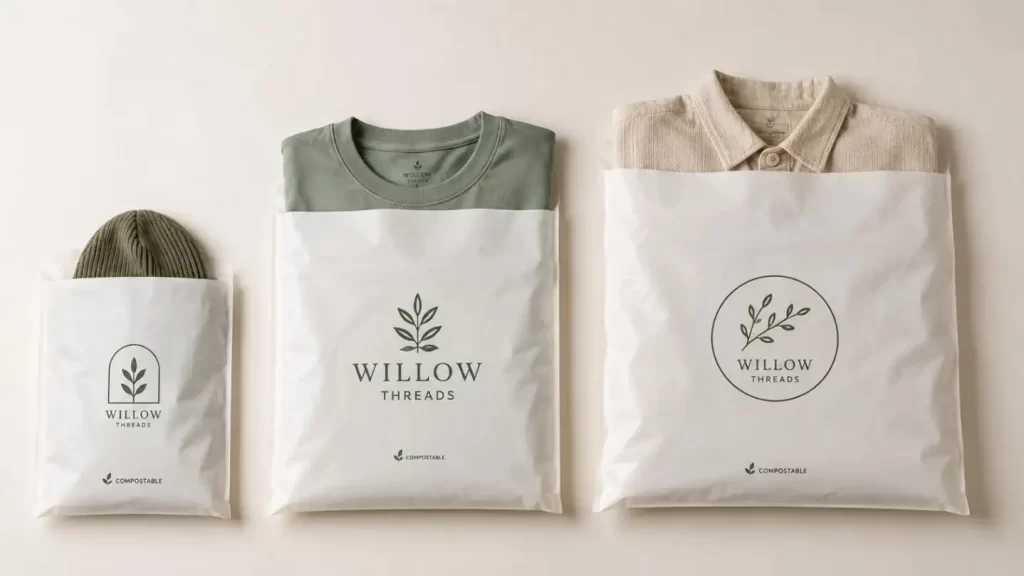
How to Select the Right Size Mailer
Selecting the size mailer that is the smallest you can reasonably use will contain the contents and use the least material.
•25 × 35 cm: accessories, thin garments, underwear, or small textile products
•30 × 40 cm: folded T-shirts, shirts, dresses, and lightweight knitwear
•33 × 38 cm: wider garments or orders requiring additional horizontal space
When you are ordering Custom Logo Compostable Poly Mailers, measure the item while folded to provide space for padding, dust bags, and other packing materials. Stress in the seams can occur if the mailers are overfilled and unnecessarily large mailers cause an increase in shipping costs.
Certification, Inks, and Environmental Claim Risks
Verify the Finished Package
Certification for an unprinted film may not automatically apply to the final printed mailer. Buyers should request documentation that clearly identifies the tested material, thickness, ink system, adhesive, and product configuration.
Separate Compostable from Degradable
Compostable, biodegradable, bio-based, and degradable describe different material characteristics. A degradation additive alone does not prove that the package will form usable compost or leave no persistent residue.
Review the Destination Market
Packaging regulations vary by country. Each target market must have a review of the composition of the packaging materials as well as environmental claims, certification marks, disposal statements, etc. Products that contain D2W or similar oxo-degradable additives, must have specific review and attention for markets that restrict the use of oxo-degradable plastics.
How GT GROUP Supports Custom Packaging Projects
GT GROUP helps fashion and e-commerce businesses develop branded mailers for lightweight, non-fragile products. Its customization process can include:
•Logo and graphic placement
•Printed brand or disposal information
•Size selection based on folded product dimensions
•Confirmation of color and layout before production
•Flexible film structures for apparel packaging
•Heat-sealed edges for consistent closure
Available sizes include 25 × 35 cm, 30 × 40 cm, and 33 × 38 cm. Before production, GT GROUP can help buyers confirm whether the available documentation supports "compostable," "certified compostable," or "biodegradable" wording for the intended market.
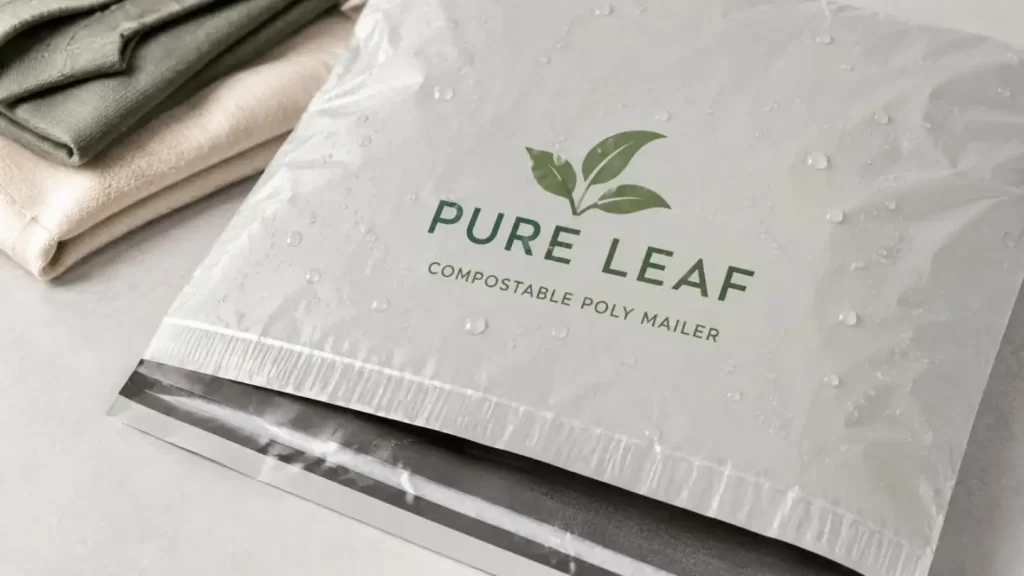
Building More Credible Sustainable Fashion Packaging
Effective sustainable packaging is more than an update of the materials used. Companies need to remove excess packaging, choose the right size, keep contents safe during transport, make substantiated claims and recommendations for the environment, and offer clear guidance on how to dispose of the packaging.
GT GROUP custom manufactures mailers designed to protect and reduce the cost of shipping clothing and similar items sold online. Each mailer contains 50 units and costs between $8.50 and $9.50. Customers use an online portal to select their preference for mailer size, upload their logo, and choose their material.
FAQs
Q1. What Custom Logo Compostable Poly Mailers does GT GROUP sell?
GT GROUP sells Custom Logo Compostable Poly Mailers for clothing, accessories, and other lightweight non fragile items. They allow buyers to add logos and graphics as well as brand information and disposal instructions.
Q2. What are the available sizes from GT GROUP?
GT GROUP currently has:
•25 × 35 cm
•30 × 40 cm
•33 × 38 cm
The size should be chosen based on the clothing item's dimensions when folded, along with any additional packaging and the sealing allowance.
Q3. How many GT GROUP mailers come in a bag?
There are 50 mailers in each GT GROUP bag. This quantity is often suitable for small fashion brands, promotions, packaging samples, and businesses testing a custom design.
Q4. How much do GT GROUP Custom Logo Compostable Poly Mailers cost?
The price is between $8.50 and $9.50 per bag of 50. The price can vary based on the size, artwork, printing, colors, and how many are ordered.
Q5. Does GT GROUP print a fashion brand's logo on the mailers?
Yes. Buyers can provide a logo and or artwork to be drawn to final size and placement. This includes confirmation of design, colors, and printed details.
Share on Social:


