


Best Rigid Mailer for Shipping Photos


Shipping photos, prints, and artwork requires packaging that prevents bending, creasing, and surface damage. Unlike ordinary envelopes, rigid mailers provide extra structural support to help photographs arrive in good condition.
Choosing the right mailer depends on photo size, paper thickness, shipping distance, and protection requirements.
1. What Is a Rigid Mailer?
A rigid mailer is a flat, sturdy mailing envelope designed to protect documents, photographs, prints, and other thin products during transportation.
Common materials include paperboard, kraft board, and corrugated cardboard.
Rigid mailers are useful for:
-
Printed photographs
-
Art prints and posters
-
Greeting cards
-
Certificates and documents
-
Small photographs and collectible prints
Their firm construction helps reduce bending and folding during normal handling.
2. Best Types of Rigid Mailers for Shipping Photos
| Mailer Type | Main Benefits | Best Use |
|---|---|---|
| Rigid Paperboard Mailer | Lightweight and flat | Standard photo prints |
| Kraft Rigid Mailer | Durable paper-based construction | Photographs and documents |
| Corrugated Mailer | Better structural protection | Larger or valuable prints |
| Stay-Flat Mailer | Helps prevent bending | Professional photo prints |
| Padded Mailer | Provides cushioning | Photos requiring additional surface protection |
For most standard photo prints, a rigid paperboard or stay-flat mailer is a practical starting point. Larger or more valuable prints may need additional protective layers.
3. How to Choose the Right Mailer Size
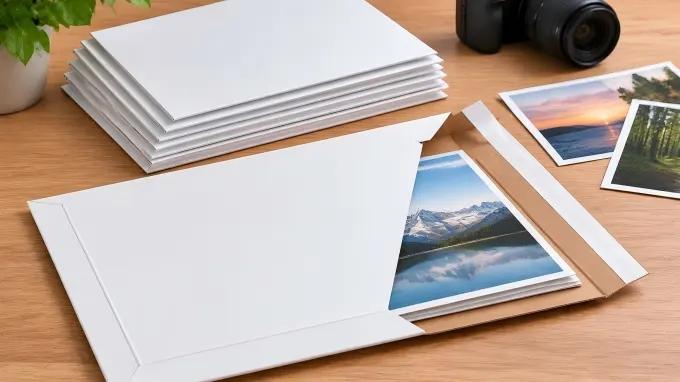
The mailer should be slightly larger than the photograph, leaving enough room for protective sleeves or backing boards.
| Photo Size | Suggested Mailer Size |
|---|---|
| 4 × 6 inches | 5 × 7 inches |
| 5 × 7 inches | 6 × 8 inches |
| 8 × 10 inches | 9 × 11 inches |
| 8.5 × 11 inches | 9 × 12 inches |
| 11 × 14 inches | 12 × 15 inches |
These are suggested starting sizes. Check the actual internal dimensions because flap design and board thickness can affect usable space.
4. How to Protect Photos During Shipping
Even rigid mailers need proper packing.
-
Place photos inside a protective plastic sleeve.
-
Add a firm backing board to reduce bending.
-
Use a suitable rigid mailer with a secure closure.
-
Avoid oversized packaging that allows prints to move.
-
Add a clear handling label when appropriate.
For glossy photographs, use a clean protective sleeve to help prevent scratches and fingerprints.
5. Custom Rigid Mailers for Photo and Print Businesses
Photographers, print studios, and ecommerce sellers often need packaging that matches their product dimensions and shipping requirements.
At MailersFactory, we provide mailing and packaging solutions for different business applications.
Explore our rigid mailer packaging solutions for options suitable for documents, photographs, prints, and other flat products. Custom sizes, materials, and printing can help businesses create more consistent packaging.
Frequently Asked Questions
1. What is the best mailer for shipping photographs?
A rigid paperboard or stay-flat mailer is generally suitable for standard photo prints because it helps prevent bending.
2. Should I use a backing board when mailing photos?
Yes. A firm backing board adds support and helps reduce the risk of creases during handling.
3. Are padded mailers good for photos?
They provide cushioning, but may not prevent bending as effectively as rigid mailers.
4. Can rigid mailers protect large photo prints?
Yes, provided the mailer is correctly sized and sufficiently rigid. Larger prints may also need additional protective boards.
Conclusion
The best rigid mailer for shipping photos should provide sufficient stiffness, a suitable fit, and secure closure. For everyday photo prints, paperboard and stay-flat mailers are practical choices, while larger or valuable artwork may require stronger corrugated packaging.
Share on Social:


- PREV: Poly Mailers vs Shipping Boxes: Cost and Protection
- NEXT: Null
