


Are Eco Friendly Compostable Mailing Bags Really Plastic-Free? A Material Breakdown


Are Eco Friendly Compostable Mailing Bags really plastic-free? Not necessarily. Eco Friendly Compostable Mailing Bags can replace conventional polyethylene mailers, yet many are still made from polymer films containing PLA, PBAT and thermoplastic starch. These materials may be compostable under defined conditions, but that does not automatically make the finished bag plastic-free, entirely plant-based or suitable for home composting.

At GT GROUP, we treat these as separate technical questions. A responsible packaging specification should identify the material source, composting route, finished-product certification and shipping performance before an environmental claim is printed.
Plastic-Free, Biobased and Compostable Are Not Synonyms
"Plastic" describes a material class. "Biobased" describes where its carbon originates. "Compostable" describes its behavior in a specified biological treatment process.
| Term | Technical Meaning | What It Does Not Prove |
| Plastic-free | Excludes materials defined as plastic under a stated policy | Renewable content or compostability |
| Biobased | Fully or partly derived from biomass | Biodegradation |
| Biodegradable | Biodegrades under stated conditions | A defined time or waste stream |
| Compostable | Meets disintegration, biodegradation and compost-quality criteria | Home, soil or marine degradation |
| Fossil-free | Excludes fossil-derived feedstock | Compostability |
The European Commission notes that compostable plastics can be made from biological or fossil resources and typically require industrial composting collection. Therefore, Eco Friendly Compostable Mailing Bags should not be described as "plastic-free" unless the complete structure supports that specific claim.
Material Logic Behind Eco Friendly Compostable Mailing Bags
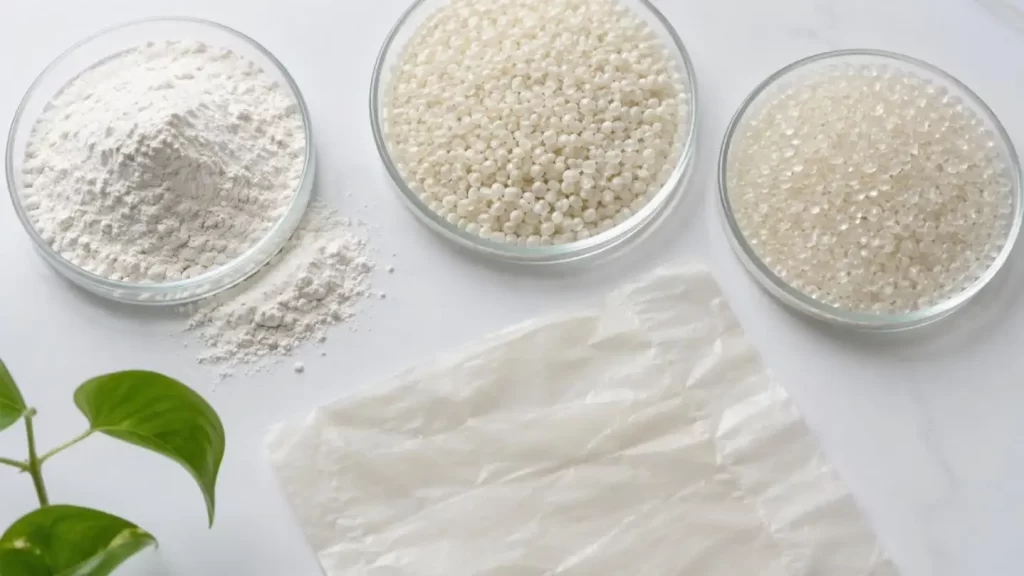
A shipping film needs flexibility, strength and reliable sealing. Plant starch alone is generally too moisture-sensitive and brittle, while PLA alone can be too stiff. Manufacturers consequently use engineered blends.
| Component | Primary Function | Material Limitation |
| Plant or thermoplastic starch | Adds renewable content and supports biodegradation | Moisture sensitivity and limited toughness |
| PLA | Provides stiffness, strength and processing stability | A plastic polymer with relatively low flexibility |
| PBAT | Improves elongation, tear resistance and heat sealing | Usually fossil-derived despite being compostable |
| Colorants and processing aids | Control appearance and film conversion | Must be compatible with the final compostability claim |
| Printing inks and adhesive systems | Enable branding and closure | May change the certification scope |
GT GROUP works with plant starch, PLA and PBAT material systems for compostable mailing applications. For Eco Friendly Compostable Mailing Bags, the formulation must be selected around the packed product rather than a single preferred material percentage.
For example:
•Increased PLA will lead to increased stiffness and decreased film flexibility.
•Increased PBAT will lead to an increase in elongation and seal performance but have less biobased content.
•An increase in starch content will support the renewable content objective, but may lead to issues with moisture stability.
•Increased thickness will also improve puncture resistance, but will require more material for each parcel.
•These are formulation trade-offs—not standalone product benefits.
Why "100% Compostable" Still Requires Qualification
"100% compostable" should describe the complete bag, not simply the base resin. The assessment may need to cover:
•Blown film at the specified thickness
•Color masterbatch and printing inks
•Side- and bottom-seal construction
•Pressure-sensitive adhesive
•Release liner
•Labels or added components
•Final printed product
ASTM D6400 addresses plastic end items intended for municipal or industrial aerobic composting. BPI uses ASTM D6400 as its base assessment for eligible commercial-compostable products. European projects commonly refer to EN 13432. However, compliance with an industrial standard does not prove home compostability.
For GT GROUP projects, the destination market should be confirmed before material and artwork approval. If certification is required, buyers should verify:
- Certificate holder and issuing body
- Certificate number and validity
- Exact product or resin covered
- Approved film thickness and color range
- Whether printing and closure components are included
- Correct disposal wording and certification-mark authorization
Shipping Performance Cannot Be Assumed
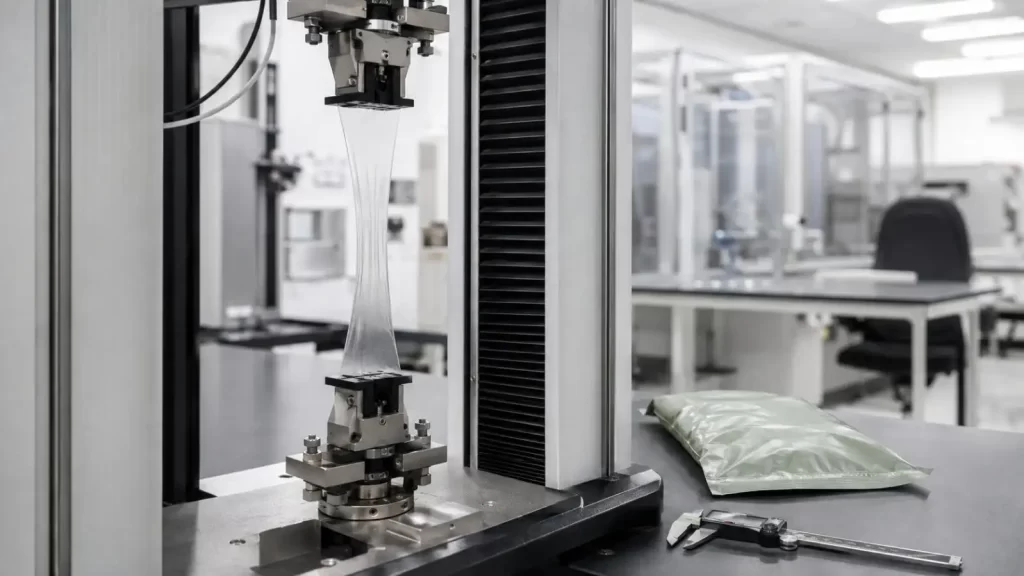
A compostable film still has to function as transport packaging. Before approving Eco Friendly Compostable Mailing Bags, buyers should evaluate the finished bag under realistic packing and distribution conditions.
Mechanical Checks
•Tensile strength in machine and transverse directions
•Elongation at break
•Tear propagation
•Puncture resistance around product corners
•Seal strength after conditioning
•Drop or filled-bag handling performance
Conversion and Use Checks
•Film gauge consistency
•Coefficient of friction for packing-line handling
•Print adhesion and rub resistance
•Adhesive closure performance
•Blocking during storage
•Resistance to light moisture
GT GROUP supports custom size, thickness, color, printing and sealing development. Pre-production samples allow buyers to assess dimensions, film feel, print clarity and seal integrity with the actual product before bulk manufacturing.
Compostable Does Not Mean Compostable Everywhere
The disposal pathway determines whether Eco Friendly Compostable Mailing Bags can deliver their intended end-of-life performance.
| End-of-Life Route | Practical Interpretation |
| Industrial composting | Controlled temperature, moisture and microbial activity; certification and local acceptance are still required |
| Home composting | Lower and less consistent temperatures; separate evidence is necessary |
| Landfill | Conditions may suppress effective biodegradation |
| Open soil or marine environment | Degradation must not be assumed without specific testing |
| PE recycling stream | Compostable polymers may be incompatible with conventional film recycling |
A compostable mailer is not permission to litter. Brands should print disposal instructions that match the collection infrastructure in the destination market. If customers cannot access an appropriate composting stream, the practical environmental outcome may differ from the laboratory result.
A More Defensible Packaging Decision
Eco Friendly Compostable Mailing Bags containing PLA or PBAT remain polymer-based packaging, even when designed to replace conventional polyethylene and compost under controlled conditions. Their suitability should be judged through formulation transparency, finished-product evidence, shipping performance and locally available waste treatment—not an unqualified plastic-free statement.
GT GROUP advises brands creating a mailer program with composable packaging on material selection, thickness, coating, printing, packed-product risk, and country-specific documentation. A claimed end-of-life for a sample aids responsible mass production for the program.
FAQs
Q1. Are GT GROUP’s Eco Friendly Compostable Mailing Bags plastic-free?
They are designed as alternatives to conventional polyethylene mailers, but formulations containing PLA or PBAT remain polymer-based. Buyers should distinguish "free from conventional PE" from a completely plastic-free claim.
Q2. What materials does GT GROUP use for compostable mailing bags?
GT GROUP works with material systems based on plant starch, PLA and PBAT. The formulation can be selected according to flexibility, strength, sealing performance and the intended composting route.
Q3. Does GT GROUP support custom sizes and thicknesses?
Yes. GT GROUP supports customized dimensions, film thicknesses and bag structures. Final specifications should reflect the packed product’s size, weight, edges and expected shipping conditions.
Q4. Can GT GROUP print custom branding on compostable mailers?
Yes. Buyers can customize colors, logos, patterns and packaging messages. Printing inks, colorants and adhesive components should be reviewed as part of the finished-bag compostability assessment.
Q5. Does GT GROUP provide OEM and ODM services?
Yes. GT GROUP provides OEM and ODM support covering material selection, sizing, thickness, printing, sealing methods and packing configurations for wholesale packaging projects.
Share on Social:


